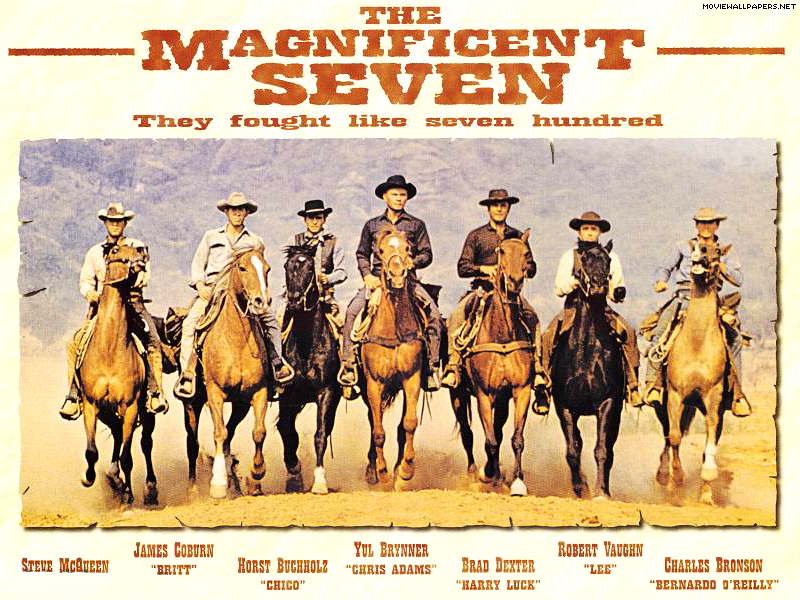
The Magnificent Seven (1960) Starring: Yul Brynner, Eli Wallach, Steve McQueen. Charles Bronson, Robert Vaughn, Brad Dexter, James Coburn, Horst Buchholtz. Directed by John Sturges. Screenplay by William Roberts, Walter Newman. Based on the Japanese film Shichinin no samurai, written by Akira Kurosawa, Shinobu Hashimoto and Hideo Oguni (Toho Company, Ltd. 1954). Produced by John Sturges. Executive Producer: Walter Mirisch Run Time: 128 minutes. U.S. Color, Western
Hollywood has long had a fondness for taking foreign films and remaking them. Case in point Shichinin no samurai aka The Seven Samurai directed by Akira Kurosawa. Released in 1954, the film was an International success for Kurosawa. The film opened in the U.S. on November 19, 1956, and would be nominated for two Academy Awards in 1957 to go along with the three BAFTA nominations from 1956. By May 1958, actor Yul Brynner’s Alciona Productions, Inc. had secured the rights to The Seven Samurai with Lou Morheim to co-produce and by October had registered the name The Magnificent Seven.
 |
| Akira Kurosawa's The Seven Samurai was the inspiration for The Magnificent Seven. |
Brynner was originally slated to direct the film and Anthony Quinn was set to star. Walter Bernstein was hired to write the screenplay and there was talk of the likes of Clark Gable, Stewart Granger, Glenn Ford and Anthony Franciosa to star. In April 1959, Martin Ritt replaced Brynner as the director and the actor took the lead role in the film. Later that year, Brynner sold his rights to the Mirisch Company, who hired Walter Newman to write the screenplay. Development continued with Dean Jones being considered for a role and Steve McQueen actually being hired. McQueen was already a Western star on TV’s Wanted Dead or Alive.
Early in February 1960, Anthony Quinn, who was no longer a part of the project, sued. He would lose that case but would file suit again in 1964.
Shooting began on February 26, 1960, at Estudios Churubusco, Mexico City, but things were far from smooth sailing. Morheim, who had been replaced as a co-producer, filed suit but settled for a share of the profits rather than on-screen credit. And there was the Screen Actors Guild strike from March 7 to April 18, 1960, which delayed things. According to his then wife, Neile Adams, McQueen even faked a car accident to get time off Wanted Dead or Alive so he could shoot the movie.
 |
Publicity photo taken during the filming from left to right: James Coburn (Britt),
Robert Vaughn (Lee), Steve McQueen (Vin), Yul Brynner (Chris Adams), Horst Bucholtz (Chico),
Charles Bronson (Bernardo) and Brad Dexter (Harry). |
The Mexican government wanted and got a Mexican depicted as one of the seven heroes. The character Chico was played by German newcomer Horst Buchholtz. But the Mexican government was completely satisfied. A Mexican censor was present on the set and caused further changes to be made. William Roberts was hired to doctor the screenplay on location. Newman took offense and lobbied to get his name removed from the credits.
Budgeted at $2,000,000, the film wrapped on May 3 and was released on November 23, 1960, featuring a score by Elmer Bernstein.
The film opens in the small village of Ixcatian. The farmers are poor and barely making ends meet. At harvest time, bandit leader Calvera (Eli Wallach) and his band of forty men descend on the village and plunder, taking food and goods. This is a common occurrence and the men in the village, with the exception of one, do nothing to stop the bandits. The one farmer who is fed up is shot dead by Calvera.
 |
| Eli Wallach plays Calvera, a bandit who leads a band of 40 men. |
After the bandits leave town, the farmers finally decide they have to do something and seek the advice of the Old Man (Vladimir Sokoloff), a village elder. He tells them to go to the border and buy guns to defend themselves. When they tell him they don’t have the money, he gives them a gold watch to sell.
 |
| Three villagers head into a border town looking for help for their village. |
Three villagers, led by Hilario (Jorge Martínez de Hoyos), travel to a border town but get caught up in the spectacle going on. Two traveling salesmen (Val Avery and Bing Russell) have paid Chamlee the Undertaker (Whit Bissell) to bury a stranger, an Indian, they found dead on the sidewalk. Chamlee tells them that he can’t go through with it, as the driver of his bigoted carriage refuses to take the casket to Boot Hill.
 |
Traveling salesmen (Bing Russell and Val Avery) are told by Undertaker (Whit Bissell)
that the funeral they paid for can't go through. |
Chris Adams (Yul Brynner), a drifter in town, offers to drive the carriage and Vin (Steve McQueen), another drifter, volunteers to ride shotgun. On the way, they’re shot at but kill the shooter. At the cemetery, a group of villagers tries to block their way. When two of the men draw guns, Chris shoots and wounds them both. The funeral can then go forward.
 |
| Drifters Chris Adams and Vin volunteer to take the casket to Boot Hill. |
The villagers approach Chris and tell him about Calvera. He asks if they’ve gone to the federales, but they explain they can’t guard their village indefinitely. Rather than help them buy guns, Chris offers to help them round up a team of gunfighters. The villagers agree, but can only afford $20 for six weeks work, though they will also feed and house the men.
Chris spreads the word he’s looking for men. One of the first to apply is Chico, who, like the villagers, had admired the way Chris and Vin handled the funeral procession. He’s young and impetuous and is embarrassed when he fails Chris’s test on his quick draw. Soon afterward an old friend of Chris’ and a treasure hunter, Harry Luck (Brad Dexter), joins up. Vin also joins as well.
 |
| Vin joins the group that will eventually number 7. |
The next day, Chris and Vin recruit half-Mexican half-Irish Bernardo O’Reilly (Charles Bronson) to join the team. Chris then observes Britt (James Coburn), an expert knife-thrower and gunman, win a draw with a deadly knife throw and considers him worthy as well.
 |
| Britt, an expert knife-thrower, is challenged. |
That night, Chico shows up at the bar where the men have gathered and holds Chris at gunpoint, ordering him to draw. But Chris refuses and eventually the drunken Chico passes out. Britt joins the group and when they return to his room, Chris and Vin find Lee (Robert Vaughan) waiting for them. Well-dressed, but destitute and on the run, Lee needs the $20 to get himself out of debt.
When the six men ride with the villagers to Ixcatian the next day, they are shadowed by Chico. Softened by the young man’s resolve, Chris allows him to join the group.
Arriving at the village, there is no reception for the men. Chris accepts the villagers' reluctance, but Chico openly rants about their cowardice. But the next day is the anniversary of the village’s founding and the seven attend the celebration but notice the absence of the village’s women.
During the fiesta, Chris learns that three of Calvera’s men are nearby and sends Britt and Lee to bring the men back alive. However, Chico follows and inadvertently ruins the plan by shooting and killing one of the bandits. This forces Britt to kill the other two, one of who is about to escape on horseback, with a long distance shot. When Chico compliments Britt about his marksmanship, Britt complains “I was aiming for the horse.”
 |
| Trying to teach the villagers to shoot. |
Back at the village, Chris readies everyone for the expected raid by Calvera. Over the next few days, the Seven use the dead men’s guns to train the farmers how to shoot. One day, while practicing his skills as a bullfighter with tame farm animals, Chico spies Petra (Rosenda Monteros) watching him. He learns from her that the villagers have hidden their women, fearing the gunslingers would rape them. Convinced that they have more to fear from Calvera then from them, Chris convinces the villagers to return the women.
 |
| Petra (Rosenda Monteros), a village girl, catches Chico's eye. |
That night, the women prepare a feast for the Seven, but when they learn that the villagers subsist on beans, the Seven share their food with the villagers.
The next day, Chris is warned by the boys standing guard that Calvera and his men are approaching. When Calvera arrives, he is greeted by Chris, Vin, and Britt. Rather than flinch, Calvera offers to share the village with the Seven if they stand down. But when Chris orders him to ride on, a gunfight erupts. Unprepared for the gunfighters, Calvera and his men try to escape but are trapped by the newly built walls and nets erected by the villagers, thus allowing the Seven and the villagers to kill many of the banditos before Calvera and his remaining gang can escape.
 |
| Chris and the seven confront Calvera and his men when they ride into town. |
That night, the villagers celebrate their success and toast the Seven, but gunshots interrupt the festivities and Chris sends O’Reilly, Vin and Sotero (Rico Alaniz) to find the sharpshooters. While they are searching, Sotero tells Vin that he is committed to protecting his family. Vin, in return, lets him know that he envies his familial bond, which he nor any of the other six have in their lives.
Even though her father forbids her, Petra is love-struck for Chico and begs him to be careful. But instead, in an effort to prove himself to the others, Chico sneaks into Calvera’s camp, hiding his face under a sombrero.
Meanwhile, back at the cantina, where the gunslingers and villagers congregate, Harry tries to get the villagers to admit there is a stash of gold or silver treasure, rumored to being buried in the nearby mountains, that is really behind Calvera’s raids, but there is no gold.
No one in the banditos' camp recognizes that Chico does not belong, not even Calvera. When Chico returns to the village, he informs the others that Calvera will be attacking soon because his men are starving. This news sets the villagers against each other as some would rather surrender to save their families than continue to fight.
The next evening, Chris and his men find that Calvera’s camp is empty, but when they return to the village, they find that Sotero has let the banditos back into the village. The Seven are surrounded. Calvera allows Chris and his men to leave, as long as they surrender their weapons. He tells Chris that he could kill them, but he doesn’t want the U.S. to learn about his operation. He offers to return their guns once they’re out of town. Calvera asks why they got involved with the villagers in the first place, Vin replies with a joke about a When someone asking a man why he threw himself into a prickly pear cactus, to which the man replies that it “seemed to be a good idea at the time.”
Before he leaves, O’Reilly explains to the boys who have been shadowing him that they should respect their fathers, who are truly brave for carrying out their family responsibilities, something he does not have the courage to do.
After the Seven are escorted from the village, they are given back their weapons. Chico explodes with anger at their treatment by the villagers, but Chris reminds him that he feels that way because he is the son of a similar Mexican villager. At this point, Harry, who is now convinced there is no treasure, decides he’s had enough and leaves.
 |
| The Magnificent Seven in action. |
The next day, the six remaining go back to the village and engage in a shootout with Calvera’s men. Harry returns unexpectedly but is shot and later dies. Lee, who has been unable to draw his weapon, pulls his gun for the first time and kills four of Calvera’s men, before being killed himself. Inspired by the Seven, the villagers, including the women, come out of hiding and attack Calvera’s men. Calvera, wounded by Chris and dying, still can’t get over the fact that the Seven would return.
 |
| Lee overcomes his fear and joins in the fight. |
Britt, who kills four banditos with perfect shooting, dies from wounds he suffered in the battle. O’Reilly is found dying by his boys and with his dying breath tells them to emulate their fathers and not him.
In the end, four of the seven are dead and those remaining of Calvera’s band have fled. As the three remaining, Chris, Vin and Chico, are leaving town, it is obvious to Chris that Chico can’t stop thinking about Petra, who is working nearby. Chris turns to Chico and tells him “Adios” and he and Vin watch Chico return to Petra and remove his gun belt, symbolizing that his short-lived gunslinging days are over and he’s ready to settle down with Petra to be a farmer.
After that, Chris and Vin ride off, leaving Ixcatian behind them.
Judging by the box-office, the film was not a runaway hit. Film rentals, not box-office gross, were $2.25 million, so the film was profitable. And as much as Hollywood likes to remake foreign films, they love a sequel more. This film spawned three: Return of the Seven (1966) starring Yul Brynner and Robert Fuller and directed by Burt Kennedy; Guns of the Magnificent Seven (1969) starring George Kennedy and James Whitmore and directed by Paul Wendkos; and The Magnificent Seven Ride! (1972), starring Lee Van Cleef and Stefanie Powers and directed by George McCowan. Not surprisingly, none of these films were as successful as the original, but isn’t that usually the case with sequels? But good stories never die, especially when a studio already owns them. M-G-M, which bought up United Artists, produced a 1998-2000 television series, The Magnificent Seven, starring Michael Biehn and Eric Close, with guest star appearances by Robert Vaughn. The film was remade in 2016 by M-G-M and Columba Pictures with Denzel Washington, Chris Pratt, Ethan Hawke, Vincent D'Onofrio, Lee Byung-hun, Manuel Garcia-Rulfo, Martin Sensmeier, Haley Bennett and Peter Sarsgaard starring.
At the time of release, the original film was met with less than stellar reviews, being compared as inferior to the Japanese original. The film was to quote Howard Thompson of the New York Times as “pallid, pretentious and overlong reflection of the Japanese original". We’ll come back to the overlong criticism later. Kurosawa apparently liked the film so much that he sent the director Sturges a sword. The film’s reputation since its release has only gone up and it is the second most televised film in U.S. history behind only The Wizard of Oz (1939).
Criticized as being overlong (see above), The Magnificent Seven clocks in at a little over two hours. For a film with an epic sweep, the film is very well paced. John Sturges deserves a lot of credit for pulling this production together, given its location shooting, the egos on the set and the interference of the Mexican government. As far as length, given the story and in comparison with big films of today, The Seven’s runtime is not overly long.
This is a male-dominated cast, but unlike say The Expendables, these are actors who have yet to reach the peak of their careers. With so many “stars” not all of them get equal screen time, but there doesn’t seem to be anyone that you feel gets slighted. For the most part they play the sort of iconic characters they would make their careers playing. Bronson’s O’Reilly is the tough, muscle-bound man of few words he would make famous. Steve McQueen, one of the coolest actors to flicker across the silver screen, seems as right at home on a horse as he does on a motorcycle or behind the wheel of a Mustang.
But even though they are given varying amounts of screen time, I feel that we get to know a little something about each. As an example, Vaughan’s Lee is afraid he’s lost the touch, McQueen’s Vin would secretly like to settle down and Brad Dexter’s Harry Luck is always looking for the gold and treasure that he assumes is hidden somewhere. Even O’Reilly gets to have a few scenes with some village boys who are observing him and getting in the way. Their relationship is brief but both comedic and touching.
Yul Brynner stands out. The obvious lead in the film, Brynner was a sort of prototype for Hugh Jackman, an actor comfortable in a stage musical as he was playing a tough on screen. Brynner’s Chris Adams is so iconic that he essentially played the same character in the sci-fi Westworld (1973) and its sequel Futureworld (1976). In those movies, he’s an unnamed gunslinger on the wrong side of the law, but he is wearing the same outfit as he did in Seven, so the reference is clear.
Eli Wallach seems like an odd choice to play a Mexican bandito, sort of like the casting of Sam Jaffe as Gunga Din. The son of Polish Jews, Wallach was born in New York and played a variety of roles throughout his long and illustrious career. A graduate of the University of Texas, Wallach would study acting under Lee Strasberg and make his Broadway debut in 1945. His first film role was as a Southern man in Elia Kazan’s controversial Baby Doll (1956). He would go on to make over 90 films and is considered one of the great character actors of all time. Eli certainly could disappear into a part as he does here as Calvera.
Horst Buchholz, who played Chico, is another interesting actor. German-born, he began appearing in films in 1954, but was new to English-language films. He gets an Introducing credit here, as this is, while not his first English language film, was his first in Hollywood. Again, an odd choice to play a Mexican, Buchholz’s Chico doesn’t really emphasize his background. He is the love interest in the film, being the only one of the Seven to have an onscreen romantic interest. Buchholz would appear the next year as a Russian communist in love with a Coca-Cola executive’s daughter in One, Two, Three (1961), opposite the great James Cagney. In a career that might have been, Buchholz had scheduling conflicts so he had to turn down roles of Tony in West Side Story (1961) and Sherif Ali in Lawrence of Arabia (1962). And he can blame his agent for turning down the lead in A Fistful of Dollars (1964).
While we don’t usually spend much time talking about music, this film has one of the great themes, written by Elmer Bernstein. For anyone old enough to remember cigarette ads on television, the theme was used to sell Marlboro cigarettes and their Marlboro Man symbol. You cannot hear this theme and not think of the West and perhaps now, lung cancer. The score received the film's only Academy Awards nomination.
The Magnificent Seven has so much going for it. While there are Westerns that I like more than this one, you would be hard-pressed to find a better one. The epic story still comes down to the good guys versus the bad guys, which is at the essence of every great Western. An Americanized version of a foreign story with one of the great testosterone-laden casts ever assembled, The Magnificent Seven is an enjoyable and satisfying film.