Showing posts with label 1943. Show all posts

Saturday, January 26, 2019

Stubs - Cabin in the Sky


Cabin in the Sky (1943) Starring Ethel Waters, Eddie "Rochester" Anderson, Lena Horne, Louis Armstrong, Rex Ingram, Kenneth Spencer, John W. "Bubbles" Sublett, Oscar Polk, Butterfly McQueen Directed by Vincente Minnelli. Screenplay by Joseph Schrank. Based on the musical Cabin in the Sky, book by Lynn Root, lyrics by John Latouche, music by Vernon Duke, as produced by Albert Lewis in association with Vinton Freedley (New York, 25 Oct 1940). Produced by Arthur Freed Runtime: 98 minutes. USA Black and White Musical

A lot has been made from the success of Black Panther (2018), the first nearly all-Black Marvel film, which was a huge worldwide box-office success, though despite the Oscar buzz was not the pinnacle of the MCU. Major studios have shied away from all-Black films, prior, due to what they thought would be less than an International appeal for such stories. Truly, Superhero films were able to change that thinking.

Though they were few and far between, Hollywood studios have made all-Black films before. One of the first examples was Cabin in the Sky made by M-G-M, the then-dominant studio. Back then Hollywood would make film versions of Broadway musicals, now it seems to be the other way around. The original musical ran for 156 performances between October 25, 1940, and March 6, 1941, with Ethel Waters, Dooley Wilson and Rex Ingram in lead roles.

While M-G-M made the film, it was producer Arthur Freed who was very insistent on making it. The studio paid $40,000 for the film rights, helping to erase the $25,000 loss the Broadway musical producers took on their production. With a rather small budget of $679,000, one of producer Arthur Freed's least expensive musicals of the 1940s, the film went into production on August 31, 1942.

There were a lot of changes between the stage musical and the film version. To begin with, only Ethel Waters and Rex Ingram, who had appeared on stage, would appear in the film. Also, only two of the original songs from Broadway, "Taking a Chance on Love" and "Cabin in the Sky” would make it into the film.

Maybe this was a sign of the times, the film was given to a first-time director, Vincente Minnelli, to helm. There were no mainstream Black directors in Hollywood in 1942. Minnelli had only directed stage musicals and musical shorts, so while not a total newbie he was far from a big name behind the camera.

Replacing Dooley Wilson in the cast was Eddie “Rochester” Anderson, who was already famous on radio and television as Jack Benny’s man-servant on that comedian’s eponymous show. By the time he was in Cabin in the Sky, he was already the first Black American with a regular role on a nationwide radio show. He started out his career in an All-Black vaudeville revue. A song and dance man, he added comedy to his act in 1926.

Newcomer Lena Horne was also given star-billing. Horne, who had begun her career in the chorus line at the Cotton Club, had come to Hollywood via a singing career, which included replacing Dinah Shore on NBC's jazz series The Chamber Music Society of Lower Basin Street. She left that to perform in a Cotton Club-style revue on the Hollywood Sunset Strip in 1942. She would be signed by M-G-M a few weeks later. Prior to coming to M-G-M she had appeared in the musical The Duke is Tops (1938), a low-budget race movie musical, later re-released in 1943 as The Bronze Venus and; in a 1941 two-reeler, Boogie Woogie Dream, so despite rumors to the contrary, this was not her first motion picture.

The film opens with a town, somewhere in the South, all abuzz about the return of Little Joe Jackson (Eddie Anderson) to the fold. Everyone is gathered at Church waiting for him with his wife Petunia (Ethel Waters) to arrive. Petunia, unlike Joe, is a church regular on good terms with God, to whom she often prays. She’s hopeful that Joe, who now has a job as an elevator operator, will give up his gambling and womanizing ways.

At first, Rev. Green (Kenneth Spencer) wants to send the church’s Deacon (Oscar Polk) to check on the Jacksons, but is convinced that the job requires his presence. Things are progressing slowly as Petunia is ready, but Joe is still fussing with his tie. The couple, along with their neighbor and friend, Lily (Butterfly McQueen), arrive at the church. When the sinners are called to repent, Petunia is convinced that Joe is in their number but he’s not.

Having been called out of church by those he owes gambling debts to, Joe is forced against his will to take on a bigtime gambler at Jim Henry’s Paradise Club, Domino Johnson (John W. "Bubbles" Sublett). The men will stake him and it is his only way to get out of their debt since he doesn’t have the money he already owes them.

When Petunia realizes Joe is not at the front of the church to repent, she and Lily go looking for him. Her first thought is to check on the Paradise Club, but gives Joe too much credit and goes home. However, he’s not there. In the distance, she hears gunfire and knows instinctively that Joe is involved.

Rushing to the Paradise Club, she finds Joe has been shot by Domino, who has fled the scene. She takes him back to the house, where the Doctor (Clinton Rosemond) warns her to take it slow. Petunia prays over her husband, asking for God’s forgiveness. However, it appears to be too late, as Lucifer, Jr. (Rex Ingram) and three of his aides come to collect Joe’s soul. Joe, at first, thinks it is his old friend Lucius (Rex Ingram), only to learn that he’s dead and is to report to duty.

A rude awakening, Little Joe (Eddie Anderson) discovers that he's died and gone to Hell.

Petunia’s prayers, though, are answered with the arrival from Heaven of The General (Kenneth Spencer). They engage in a battle for Little Joe’s soul. Sgt. Fleetfoot (Oscar Polk) is sent to Heaven to get the judgment on Little Joe. While he’s gone, Lucifer, Jr. predicts that Little Joe’s involvement with local vamp Georgia Brown (Lena Horne) will result in his banishment to Hell. Fleetfoot arrives back with the Lord’s judgment. While he’s not worthy of going to Heaven, the Lord gives him six more months on Earth to prove his worth.

Joe’s soul is more than willing to make changes, but he’s informed by The General that human Joe will have no recollection of what has happened but assures him that he will be talking to his conscience and battling for his soul, knowing that Lucifer, Jr. will be playing to his baser desires.
When Joe, who had been thought to have died, suddenly recovers, Petunia believes it’s a miracle.

Petunia (Ethel Waters) comforts Little Joe as he recovers.

Petunia, who is a loving wife, can’t do enough for Joe during his recovery. About a month in, two of Joe’s gambling pals, Jim Henry (Ernest Whitman) and Dude (Nicodemus) come to call. They’re after the debt that Joe owes them, $6 and $4 respectively. Petunia intercepts them and makes a wager, she’ll roll them dice for double or nothing. She takes a few practice throws with the dice that Jim Henry provides. However, when she offers to let him throw, he changes them, which she, of course, notices. She takes back the dice and throws 7 and 11 and wins back the debts and chases the two away.

Using their dice, Petunia wins back Little Joe's debts from Jim Henry and Dude (Nicodemus).

Joe gets a job at a factory and fulfills his promise to buy Petunia an electric clothes washer, which he delivers to her during his lunch hour on her birthday. “Now all we need is electricity,” he tells her.
Don’t think for a minute that Lucifer, Jr. has given up on his wager. Back at the Hotel Hades, Lucifer, Jr. and his ideas men, played by Mantan Moreland, Willie Best, Fletcher Rivers, and Leon James Polk are joined by Trumpeter (Louis Armstrong), who comes up with the suggestion to have Joe win the Irish Sweepstakes. A lot of money is the quickest way to turn a man into a sinner. Adding to the mix of temptations is Georgia Brown, whom Lucifer, Jr. convinces to unexpectantly go see Joe.

Louis Armstrong (l) listens as Lucifer, Jr. (Rex Ingram) gets clearance for his plan for the big guy.

At work, that afternoon, Joe receives a telegram from the Messenger Boy ('Buck' Ford Washington Lee). Alas, Joe doesn’t know how to read and assuming it is only some sort of advertisement, throws it away to The General’s pleasure. Joe goes home and misses Georgia’s arrival. She is about ready to leave when Lucifer, Jr. uses his powers of persuasion to get her to pick up the telegram and read it.

Meanwhile, Joe goes home but Petunia is out. Lily tells him that Petunia has gone to buy him some clothes. Joe starts to repair the roof, which is in the process of falling down but, to the disappointment of The General, decides to put it off for another day.

Georgia Brown (Lena Horne) proves to be a great temptation for Little Joe.

While he’s relaxing outside, Georgia Brown arrives. Joe tries to be strong but Georgia is awfully tempting. He starts to kiss her but pulls back, telling her he can’t go through with it anymore. She shows him the telegram offering him $50,000 for his lottery ticket and he thinks of all the things he can do for Petunia. He also promises to give Georgia something for bringing him the good news.

Unfortunately, that is the moment Petunia arrives home. She won’t let Joe explain and kicks him out of the house.

Domino Johnson (John W. "Bubbles" Sublett) arrives at the Paradise Club.

Later, Duke Ellington and his orchestra are playing at the Paradise Club, Domino, fresh from six months in prison, arrives. He’s looking for Georgia Brown and Jim Henry puts him off, sending him upstairs to the card game in progress. Joe and Georgia then arrive dressed to the nines and her dripping with jewelry. Joe is now a high roller, who is lavishing his wealth on Georgia and being the big man down at the Club. Not only does he buy everyone at the Club a drink, but he is also the one to have paid for Ellington’s appearance.

Domino makes a play for Georgia even though Joe is the one who brought her.

When Domino learns that Georgia is there, he makes an obvious play for her, right in front of Joe. But Petunia is also there, having come, dressed up as well, demanding half of Joe’s winnings in their divorce. She makes a play for Domino, through singing, but Joe can’t let that happen. He fights for Petunia and Domino pulls out a gun.

Petunia makes a play for Domino, which is the last straw for Little Joe.

Petunia prays for God to intervene, which takes the form of a tornado headed for the club. Despite the winds ripping the Paradise Club apart, Domino manages to fire his gun, first killing Petunia and then Little Joe.

The General (Kenneth Spencer) informs Petunia that she's made it into Heaven. Little Joe has not.

The night, which is exactly six months since Little Joe’s reprieve, has turned the Club into Purgatory. The General informs Petunia is eligible to pass through the Pearly Gates into Heaven, while Little Joe has been rejected. It is only after Little Joe repents and the Lord vouches for him that the General reverses his decision and allows Little Joe to join his wife in Heaven. The start to walk up the long stairs to Heaven.

Little Joe and Petunia ascend into Heaven hand in hand on their way to their cabin in the sky.

Little Joe then realizes that his brush with the afterlife was only a dream, and he vows to change his evil ways for good.

Little Joe recovers with Lily (Butterfly McQueen), Rev. Green (Kenneth Spencer),
Petunia, and the Doctor (Clinton Rosemond) watching over him.

Released on April 9, 1943, the film was a box office success despite some theaters refusing to show the film, especially in the South. In one incident, in Mt. Pleasant, Tennessee, the film was pulled after only 30 minutes by order of the sheriff. Despite the boycott, the film turned a profit, making $1.7 million in its release in the US and Canada and $234,000 in the rest of the world. With the low production costs, the profit was over $587,000. There were talks at M-G-M of doing other all-Black films, like a version of George Gershwin’s Porgy and Bess but none ever materialized at the studio.

The film did garner one Academy Awards nomination, for Best Music, Original Song: Harold Arlen (music) and E.Y. Harburg (lyrics) for the song "Happiness Is a Thing Called Joe".

Variety, in their review of the film, complained that little had changed from the stage version, noting “In the legit version Cabin seemed constantly to be constricted by the limitations of the stage. But difficulty has not been solved in the present film adaptation. The yarn still appears weighed down by unimaginative conception, the few changes in the screen medium merely filling out the story, without expanding or developing its fantasy. In only one of two moments, such as the stairway to heaven finale, is there any apparent effort to utilize the facilities of the camera. There are far too many close-ups, particularly in the vocal numbers.”

Variety's review singles out only Ethel Waters, stating she “remains the one transcendent asset of the film Cabin, just as she was in the original. Her sincerity, compassion, personal warmth and dramatic skill, plus her unique talent as a singer make her performance as Petunia an overpowering accomplishment.”

Waters is clearly the star of the film. She began her career in Black vaudeville starting at the age of nine. At one time, she played the same club as Bessie Smith, who didn’t want her to compete by singing Blues songs, so Waters turned to ballads and popular tunes. She recorded for Cardinal Records. Her first hit was, however, for Columbia Records with “Dinah” in 1926. Her best-known song was “Stormy Weather” released in 1933, which would get to #1, her second song to reach that milestone.

She would appear as herself in Warner Bros. On With the Show! (1929), the first all-color all-talkie film released by the studio. (Sadly only Black and White prints remain.) and Rufus Jones for President (1933), a musical short, also released by Warner Bros., which also featured a seven-year-old Sammy Davis, Jr. Following her run on Broadway in Cabin in the Sky, she came to Hollywood to make Cairo (1942) at M-G-M and stayed to make Cabin in the Sky. She would be nominated for an Academy Award as Best Supporting Actress, for her role in Pinky (1949).

Quite talented, Waters could be difficult to work with. John Ford, who was the original director of Pinky was fired after bumping heads with her. Elia Kazan, who took over the film, would describe Waters as a "truly odd combination of old-time religiosity and free-flowing hatred.”

There were a number of firsts in Waters’ career. The first black to have a TV Special, a 15-minute variety special on NBC on June 14, 1939. In 1969, she would be nominated for an Emmy, for an appearance on Route 66, the first dramatic performance by a black performer so recognized (male or female), as well as the first black woman nominated for an Emmy.

In this film, she seems to do it all: sing, dance, and act delivering both heartfelt speeches as well as holding her own in comedic sequences, as when she takes Jim Henry’s money playing dice. While the film is about Little Joe, it seems to revolve around Waters’ Petunia character. It’s a good thing, too. Even though everyone gives strong performances, it is her talent and screen presence that the story depends on.

Eddie "Rochester" Anderson, who was already known for his comedic talents, also sings and dances a little. Even though he began his career doing these things, it is good that he didn’t quit his day job to resume his career doing either.

Lena Horne is not only a good singer but she is very attractive and provides as much distraction as any man trying to mend his ways can take.

Rex Ingram seems to have a lot of fun as Lucifer, Jr. While the part is obviously a supporting one here, it is hard to imagine anyone else playing the role with as much spirit as he does. Louis Armstrong, the great trumpet player, gets billing over Ingram, even though his part is much smaller. I’m not sure why Armstrong was cast other than to take advantage of his fame.

The vaudeville duo of Buck and Bubbles is represented, though only 'Bubbles' John W. Sublett really has much of a role as Domino Johnson. 'Buck' Ford L. Washington plays the role of the messenger and while he has a nice sequence with Anderson, his talent as a singer and piano player is not used here. Known as the father of rhythm tap, Sublett had also been featured on stage as Sportin’ Life in George Gershwin’s opera Porgy and Bess (1935). Sublett is also the one who, in 1920, gave tap dancing lessons to Fred Astaire.

Having never seen the stage musical this is based on, I don’t have Variety’s issues with the film version. For some reason, I had avoided this film for a number of years. The version I watched was one I had Tivo-ed from TCM back when the late great Robert Osborne was still the prime-time host on that channel. Now that I’ve seen it, I wonder what took me so long.

The tornado that destroys the Paradise Club is a recycled special effect from The Wizard of Oz.

There are a couple of bits that might remind you of The Wizard of Oz (1939). Some of the roles in Little Joe's dream are played by friends and neighbors. Even Joe realizes this in the dream itself but the scene when he recovers definitely will remind you of when Dorothy regains consciousness in that film. And the tornado that rocked Dorothy's world seems to return to destroy Jim Henry's Paradise Club. M-G-M, not wanting to waste a good special effect, did reuse, or at least use an alternative take, of the footage in not only Cabin in the Sky but also in High Barbaree (1947).

The film is very entertaining with strong performances from everyone. Not only do you get Ethel Waters but you also get Eddie "Rochester" Anderson, and Lena Horne at the start of her career. Seeing Louis Armstrong, and Duke Ellington is sort of icing on the cake. It’s funny, it’s spiritual and it’s very, very good. I would definitely recommend that you watch this film as soon as you can.

Saturday, October 21, 2017

Stubs - I Walked With a Zombie


I Walked With a Zombie (1943) Starring: James Ellison, Frances Dee, Tom Conway, Edith Barrett Directed by Jacques Tourneur. Screenplay by Curt Siodmak, Ardel Wray. Produced by Val Lewton. Run Time: 69 minutes. USA Black and White. Horror.

Horror, like any genre, has its variants. We tend to think of the classic horror films as monster movies, Universal’s Frankenstein (1931), Dracula (1931), The Mummy (1932) and The Wolf Man (1941) come to mind, as well The Cabinet of Dr. Caligari (1920), Nosferatu (1922) and The Golem (1915) before that. But there are other kinds, too.

While modern horror tends to go in more for gore, there are other films that are more psychological in nature and even more environmental. I Walked With a Zombie falls into these latter categories.

With the coming of Halloween, the name Val Lewton comes up more and more in film history circles. Lewton, born in 1904 in Yalta, then part of Imperial Russia, now Ukraine, as Vladimir Ivanovich Leventon, would become best known for his work in horror films produced at RKO. After immigrating from Russia in 1909 with his mother, they would settle in suburban Port Chester, NY and change their name to Lewton.

A writer by trade, Lewton attended journalism school at Columbia University and would work for a time in MGM’s publicity office in New York City. He quit that position with the success of his 1932 novel No Bed of Her Own, which later that year would be made into No Man of Her Own (1932) with Clark Gable and Carole Lombard. But after his next three novels were not as successful, he ended up working on a screen treatment for Taras Bulba for producer David O. Selznick at MGM and later when Selznick went independent.

Even though that film was never made, Lewton continued to work with Selznick for the next decade. It was Lewton that originally warned Selznick against making Gone With the Wind (1939), feeling that Margaret Mitchell's 1936 novel was unfilmable. He would later work, uncredited, on the screenplay and even be credited with the scene where the camera pulls back to reveal hundreds of wounded soldiers at the Atlanta depot, one of that film's most famous scenes.

After ten years, Lewton wanted to break out on his own and took a job at RKO studios heading a unit that was assigned to make low-budget horror films for the studio based on titles supplied by his supervisors. The first film from this unit was Cat People (1942), which on a budget of $134,000 would make $535,000 in domestic box office and a $183,000 profit, so it was considered a success. 

That film was directed by Jacques Tourneur, a Frenchman Lewton had met on the set of A Tale of Two Cities (1935), a Selznick produced film for MGM. Tourneur was a second unit director, and he and Lewton both receive credit for their work on the Revolutionary War sequence of that film.

Tourneur, who had begun his career as an editor in his native France, had come to Hollywood in 1934 under contract to MGM. He would later make his directorial debut with They All Come Out (1939), but would be dropped by the studio in 1941. He would direct Doctors Don’t Tell (1941) at RKO before reteaming with Lewton.

Following the success of Cat People, RKO executives had another title in mind, I Walked With a Zombie. Officially, the film was to be based on an article written by Inez Wallace for American Weekly Magazine, but Lewton encouraged his writers to use Charlotte Brontë's Jane Eyre to give the story a narrative structure and to do research on Haitian voodoo practices.

The screenwriters included Curt Siodmak, who two years before had written the screenplay for The Wolf Man, and Ardel Wray, who had come through RKO's Young Writers' Project. I Walked with a Zombie would be Wray’s first screenplay. While she would continue to write for Lewton’s group, she would leave Hollywood in 1945 when she gave birth to her daughter.

British actress Anna Lee was originally cast in the film as female lead Betsy. Lee, who had previously appeared in such films as Seven Sinners (1940), How Green Was My Valley (1941) and Flying Tigers (1942), had to pull out due to a previous commitment.

In her place, Frances Dee was cast. Dee had been acting in films since Playboy of Paris (1930), a musical opposite Maurice Chevalier. She would also appear in An American Tragedy (1931) as well as Of Human Bondage (1934) to name a few. The wife of actor Joel McCrea, Dee’s last film was Mister Scoutmaster (1953).

I Walked With a Zombie went into production on October 26, 1942, and would complete filming November 19, 1943. One note about Zombies. Zombies had been in films since Victor Halperin's White Zombie (1932). The term Zombie means the undead recreated through the re-animation of a human corpse. The word comes from Haitian folklore, which may explain the Caribbean setting for many zombie films like I Walked with a Zombie.

A difference should be drawn between Haitian zombies and the ones that have permeated fiction since George A. Romero's seminal film Night of the Living Dead (1968). Romero turned zombies into living monsters who crave human flesh and even eating human brains.

The film opens with narration by Betsy Connell (Frances Dee), who recounts that she once "walked with a zombie". In the distance we see her walking with a rather tall person, whom we assume is the zombie in question.

The film opens with a long shot of Betsy (Frances Dee) walking with a zombie.

A Canadian nurse, Betsy is hired to be the personal nurse to Jessica Holland (Christine Gordon) by her husband Paul Holland (Tom Conway), the owner of a sugar plantation on the Caribbean island of Saint Sebastian. It is winter in Canada and the thought of beaches and palm trees sweetens the prospects.

The thought of palm trees and beaches seals the deal for Betsy

Soon, Betsy is on board a ship from Antigua, where she is thinking about how beautiful everything looks when Paul interrupts her thoughts and introduces himself. He tells her that everything is not beautiful, but rather full of death and decay.

Paul Holland (Tom Conway) tells Betsy that everything she knows is wrong when it comes to the Caribbean.

Betsy is taken from the boat to the Holland home, referred to by the locals as Fort Holland by carriage. The coachman (Clinton Rosemond) educates Betsy telling her that Saint Sebastian is populated by the descendants of black Africans brought to the island aboard slave ships to work the sugar plantations by early descendants of the Hollands. He refers to a statue in the Holland’s courtyard as “T-Misery”; the statue is actually the masthead of the first slave ship to arrive on the island. The island residents are still somewhat bitter about the circumstances that brought them there, though many are still employed at the Sugar plantation.

On the ride to the plantation, Betsy gets a brief history lesson from the coachman (Clinton Rosemond).
Despite the misery around her, Betsy is still excited about her new surroundings. That night at dinner, Betsy is joined by Wesley Rand (James Ellison), Paul’s half-brother. Unlike Paul, who has a British accent, Wesley is more American, having been schooled there. Wesley explains that the boys share the same mother, who runs the village dispensary. Paul, though, is the son of a Holland and therefore the owner of the plantation, while Wesley is merely an employee. It is clear from the way he talks about Paul that Wesley resents him. Towards the end of their dinner, Paul arrives and Wesley retreats to the mill where he is needed. Paul is taking medicine to Jessica and even though Betsy is anxious to meet her, Paul tells her that she can start work the next day.

At dinner, Betsy is entertained by Paul's half-brother Wesley Rand (James Ellison).

After dinner, Betsy is already in bed when the sounds of a woman sobbing wake her. She follows the sounds, which are coming from across the courtyard in a stone tower.

The sound of a woman sobbing wakes Betsy.

Still following the sobbing, Betsy ascends the stairs, where she is cornered by the cataleptic figure in white, who turns out to be Jessica.

Betsy follows the sobbing up a dark windy stairway.

She has not yet met her patient and is frightened when Jessica does not respond. Betsy’s screams for help are responded to by Paul and several of the servants. Paul is disappointed in Betsy and takes Jessica back to bed.

Betsy is frightened when Jessica (Christine Gordon) does not respond.

After they’re gone, we learn that the sobs were coming from Alma (Theresa Harris, miscredited as Teresa Harris). As part of a tradition, Alma is sobbing because of the birth of a friend's child. Because of the misery of their lives, a new birth is greeted with crying by the natives.

Turns out it was Alma (Theresa Harris) who was sobbing.

The next morning, Betsy is awoken by Alma, who has brought her breakfast in bed. Alma has been taking care of Jessica and wants to take care of Betsy, too, and work with her.

Paul is upset with Betsy for what he sees as her childish behavior and warns her not to get involved with the island’s superstitions.

Betsy meets with Jessica's physician, Dr. Maxwell (James Bell), who explains that his patient's zombie-like condition was caused by an incurable tropical fever. There is no hope of ever bringing her back to normal, which Betsy doesn’t like.

Dr. Maxwell (James Bell) tells Betsy there is nothing that can be done for Jessica.

On Betsy's day off, she encounters Wesley, who offers to give her a tour of the village. That tour seems to start and end at a local café, where Wesley drinks himself into a stupor. A calypso singer (Sir Lancelot) sings a song that is about Paul and Wesley's rivalry for Jessica's love. Hearing the song upsets Wesley and the singer, who had been unaware of his presence, apologizes to Wesley.

A calypso singer (Sir Lancelot) is upset that no one has told him Wesley was in the cafe.

But later, after Wesley has passed out, the singer plays the song almost as a dare. Betsy tries to rouse Wesley, but can’t wake him. Mrs. Rand (Edith Barrett) appears out of the shadows and comes to Betsy’s aid. She arranges to have Wesley put on his horse and then walks Betsy back to Fort Holland, deciding to stay the night.

Later, with Wesley passed out, the calypso singer repeats his song about the
Holland family rivalry. Mrs. Rand (Edith Barrett), in the background, arrives to help.

Over dinner, while Paul and Wesley exchange harsh words, in the distance, drums of the voodoo ritual play.

Later, Betsy is drawn to Paul’s piano playing. Alone, he apologizes to her for bringing her to the island to take care of his wife. After their encounter, Betsy realizes that she’s in love with Paul and wants to make him happy by bringing his wife back to him.

Betsy realizes she's in love with Paul after hearing him play the piano.

She approaches Dr. Maxwell about an experimental treatment using insulin shock to cure Jessica. Everyone agrees to give it a try, but it fails.

Betsy takes Jessica to Home Fort for a voodoo ceremony.

Since medicine has failed her, Betsy listens to Alma, who suggests trying voodoo. Betsy seeks out Mrs. Rand for advice and she tries hard to dissuade her from taking that approach. However, Betsy decides to give it a try and with Alma’s help, she takes Jessica to the “Home Fort” where voodoo is practiced. Alma draws her a map and gives her patches to wear that will let them get past Carre Four (Darby Jones), the tall zombie-like figure that guards the roads to Home Fort.

Carre Four (Darby Jones) guards the way to Home Fort.

They watch the ritualistic dancing before Betsy approaches the shack where the voodoo priest resides. She is taken inside, where she learns that the priest is none other than Mrs. Rand. Mrs. Rand explains that she has been using the natives’ belief in voodoo to get them to accept modern medical practices. She tells Betsy that Jessica can never be cured.

The voodoo ceremony features ritualistic dancing.

But Jessica’s presence at Home Fort has inflamed the natives and they intensify their ritual's intent on bringing Jessica back. Hearing the drums, Paul tells Betsy that he doesn’t want to demean and abuse her the way he had Jessica and begs her to return to Canada, but Betsy refuses.

That night, though, Betsy is awakened by the formidable presence of Carre Four, who has entered the house. Fearful, she runs to Paul’s room for help and Mrs. Rand orders Carre Four away from the Holland complex and he obeys.

The next day, Maxwell informs the family that the native unrest has caused an inquest to be opened into Jessica’s mysterious illness. Mrs. Rand admits to everyone that Jessica is not sick, but a zombie put into that state by Mrs. Rand. The curse was the only way she could think of to prevent Jessica from leaving Paul for Wesley.

Mrs. Rand confesses that she put a curse on Jessica, resulting in her zombie-like state.

However, Maxwell refuses to accept that explanation, insisting Jessica is a victim of a tropical fever. He says that since Jessica never died, there is no way she could be a zombie. He leaves without knowing that at one time, Jessica had fallen into a coma, allowing her to become one of the undead.
Later that night, the beating drums call Jessica out of the house and to the front gates. Wesley notices and opens the gates for her, taking an arrow from the statue of T-Misery before following after her.

T-Misery, the statue in the courtyard of Fort Holland, is the masthead from a slave ship.

At Home Fort, the voodoo ritual is calling her towards them, using a doll on a string to symbolize her. And then the worshippers stab the doll with a pin.

The voodoo ceremony calls Jessica to them in the form of the doll.

Mimicking the ritual, Wesley thrusts the arrow into Jessica. Followed by Carre Four, Wesley carries her body into the sea, where he drowns.

After killing her, Wesley takes Jessica's body out into the sea, where he drowns.

Later, while spearfishing at night, the natives discover their dead bodies floating in the surf and carry them back to Fort Holland.

Carre Four carries Jessica's lifeless body back to Fort Holland.

I Walked With a Zombie is more atmospheric than terrifying, so in some ways it barely qualifies as a horror film. At the time of its release, April 30, 1943, it was even referred to as “dull” in a review in the New York Times, which is never a good thing. Over time, however, its reputation has done nothing but increase. In 2007, what was considered dull in 1943 was named the fifth best zombie film of all time by Stylus magazine, an online music and film magazine.

None of the leads really distinguish themselves. James Ellison, Frances Dee, Tom Conway and Edith Barrett are good, but not great in their roles. I’m not sure if I really buy Betsy falling in love with Paul and her motivation then to bring Jessica out of her comatose state. Edith Barrett is good, but her part has a little more to it than the others; a proponent of modern medicine who uses voodoo to get her viewpoint across to the natives.

Two supporting actors, Christine Gordon as Jessica Holland and Darby Jones as Carre Four, say nothing throughout the film and pretty much just stare forward with blank expressionless faces. This is Gordon’s first and perhaps best-known performance, which may tell you something about her acting chops. Gordon was out of films by 1946, her last appearance being in the remake Of Human Bondage (1946). Darby Jones was pretty much stereotyped by Hollywood. Given the era in which he worked, the 1930s through the 50s, meant that he played a lot of African natives, slaves, and zombies, many times not receiving credit.

Jacques Tourneur would continue to work for Lewton, directing The Leopard Man (1943) for the same RKO unit. When he was eventually elevated by the studio to direct A-films, he would helm one of the best film noirs ever made, Out of the Past (1947), and then Berlin Express (1948), shot against the backdrop of war-torn Allied-occupied Germany.

If you’re looking for a really scary horror film for Halloween, then you should look elsewhere. I’m not even sure that real fans of zombie flicks would get much out of it either, since, as stated before, this is not your modern zombie film. No brains are eaten or even drooled over here.

Be sure to check out other Horror films in our Horror Films Review Hub.

Saturday, July 8, 2017

Stubs - Journey into Fear (1943)


Journey into Fear (1943) Starring: Joseph Cotton, Dolores Del Rio, Ruth Warrick, Agnes Moorehead, Jack Durant, Everett Stone, Orson Welles. Directed by Norman Foster. Screenplay by Joseph Cotton and Orson Welles. Based on the novel Journey into Fear by Eric Ambler (London, 1940). Produced by Orson Welles.  Run Time: 71 minutes. USA Black and White. Drama, War, Espionage

Orson Welles made a meteoric rise in Hollywood, making Citizen Kane (1941) as his first film out of the gate. Based on his reputation from his radio work leading the Mercury Theater, RKO studios gave the neophyte unprecedented creative control over the film. While hailed as one of the greatest and most innovative films ever made, Citizen Kane, based on its pre-release controversy and uneven distribution, was not a big success at the box office, losing money in New York, Boston, Chicago, Los Angeles, San Francisco and Washington, D.C.

Still, RKO stood by him, though they did take away his final cut, prior to his next film, The Magnificent Ambersons (1942). That film would go over budget by about 20 percent and would eventually lose $620,000.

For his third film, RKO had its own plans, even though Welles wasn’t their first choice for the project, having paid $10,000 in frozen British funds for the rights to English author Eric Ambler's novel, Journey into Fear.

Originally, Ben Hecht was slated to write the script and David Hempstead was slated to produce. Then the 
studio announced that the film would star Michele Morgan and Robert Stevenson was to direct. Hempstead wanted Fred Astaire to play the lead and when he passed, Hempstead considered Robert Montgomery and Fred MacMurray.

But things kept changing and soon studio chief George J. Schaefer was trying to convince Orson Welles to act in and direct the film, but Welles was wavering between this film and another project, Louisiana Hayride, a story about Huey Long, the latter which would never be made. By mid-July 1941, Journey into Fear was being identified as a Welles’ project which he was going to produce under his Mercury Productions banner and was to help fulfill Welles’ four picture deal with RKO.

Welles was no longer set to star, however, that would go to Joseph Cotton, another member of the Mercury Theater. Welles was still set to direct until the production began on January 2, 1942, and then Norman Foster was in the director’s chair. And with another project, It's All True, taking his time, Welles’ role was reduced to three to four days of intense shooting so he could leave for Brazil on February 5th. (Spoiler alert, It’s All True never gets finished. A change in management at RKO, Schaefer resigning, left Welles without support. New management not only refused to continue to support It’s All True, but they canceled their contract with Welles and kicked Mercury Productions off their lot.)

Before the opening credits or film title appear, we see a fat man, whom we will later learn is the assassin, Peter Banat (Jack Moss), places a silencer on his gun as a broken phonograph record playing "C'est mon couer" is heard on the soundtrack. The sound from the broken phonograph will become a sound mark for Banat’s presence.

Howard Graham (Joseph Cotton) is an American armaments engineer working with the Turkish Navy. When we first see Howard, he is writing a letter to his wife, Stephanie (Ruth Warrick), explaining the circumstances that led to their separation in Istanbul, Turkey.

On their way home to the United States, the Grahams stop in Istanbul and are met by S. Kopeikin (Everett Sloane), a Turkish employee of Graham's company. Kopeikin inserts himself into the couple’s dinner and then, under the pretense of discussing business, takes Graham to a nearby nightclub.

Magician Oo Lang Sang (Hans Conreid) coaxes Howard Graham (Joseph Cotton) to be a part
 of his act, while Kopeikin (Everett Sloane) and Josette (Dolores del Rio) look on.

There Graham meets the Eurasian dancer Josette Martel (Dolores del Río) and her partner Gogo (Jack Durant). But Graham also gets dragged onto the stage by the nightclub’s magician, Oo Lang Sang (Hans Conreid), and into a disappearing act. But when the lights go out, a bullet meant for Graham kills the magician.

At the end of the trick, the magician has been murdered.

Graham is taken to meet Colonel Haki (Orson Welles), the head of the Turkish secret police. Haki is concerned for Graham's safety, but only because he has irreplaceable knowledge about the armament used by the Turkish Navy and, consequently, his death would be bad for the Navy. After showing Graham a photograph of Peter Banat, an assassin hired to kill him by the Nazi agent Muller (Eustace Wyatt), Haki tells Graham that he has arranged for him aboard a tramp steamer bound for Batumi, rather than flying there. Graham protests not wanting to be separated from Stephanie, but Haki assures him that he will personally accompany her to Batumi.

Colonel Haki (Orson Welles) promises to handle things.

At dockside, Kopeikin catches up to Graham and bids him farewell while presenting him with a pistol, for his protection. Once onboard, Graham hides the gun under his mattress. Later, he meets his fellow passengers which to his surprise includes Josette and Gogo. Also on board is Kuvetli (Edgar Barrier), a Turkish tobacco salesman; Professor Haller (Eustace Wyatt), an archeologist; and Madame Mathews (Agnes Moorehead) and her socialist husband (Frank Readick).

At dockside, Kopeikin hands Graham a handgun for protection.

Graham, who is feeling lonely and afraid, is befriended by Josette. When the ship makes its first stop, Graham cables his wife to meet him in Batumi on Saturday. When the ship leaves the port there is a new passenger; Graham is alerted to his presence by the musical strains of a record player. Haller warns him that Kuvetli is not who he claims to be.

Graham finds Josette is also on board the ship to Batumi.

At dinner that night, the new passenger joins Graham at his table and the engineer recognizes him as Peter Banat. Panicked, Graham tells the ship's captain (Richard Bennett) that there is an assassin on board, but the captain thinks that he is crazy and literally laughs in his face.

Assassin Banat (Jack Moss) is also on board, as is his employer, Professor Haller (Eustace Wyatt).

Fearing for his life, Graham discovers that his gun is missing and turns to Josette for help. After listening to his story, Josette offers to have Gogo detain Banat in a card game while Graham searches his cabin. Afterward, when he returns to his own cabin, Graham is confronted by a gun-toting Haller, who Graham identifies as Muller.

Haller notifies him that he’ll be killed soon after departing the boat, but he offers to spare Graham's life if Graham will delay his return to the States for six weeks. He explains that the Germans seek only a postponement in Graham making recommendations for arming the Turkish Navy. Haller suggests that Graham check into a hospital with a case of "typhoid." Before leaving, Haller informs Graham that Kuvetli is a Turkish agent sent by Haki. He warns Graham not to tell Kuvetli of the plans they’ve discussed. Graham’s return to America would be at risk if he does.

After Haller leaves, Kuvetli contacts Graham and instructs him to consent to Haller's plan. He tells Graham that when the ship docks in Batumi, he should hide while Kuvetli goes ashore to make arrangements for the arrests of Haller and Banat. Graham follows Kuvetli's instructions and agrees to Haller's terms, but when he goes to contact Kuvetli, he discovers the agent has been murdered and hears the familiar strains of a musical recording in Banat’s cabin.

Graham finds Turkish Agent Kuvetli (Edgar Barrier).

Desperate, Graham asks Mathews to deliver a message to the Turkish counsel. He agrees and later offers Graham the only “weapons” he has at his disposal, a pocket knife and an umbrella for protection. When the boat docks in Batumi, Banat and Haller escort Graham ashore and into a waiting car. As they are driving, one of the car's tires goes flat and when the driver leaves his seat to examine the tire, Graham sticks the pocket knife into the horn, causing it to sound off and stay on. During the ensuing commotion, Graham jumps into the driver's seat, purposefully crashes the car into a store window and escapes his captors.

Haller and Banat take Graham hostage as soon as he gets off the ship.

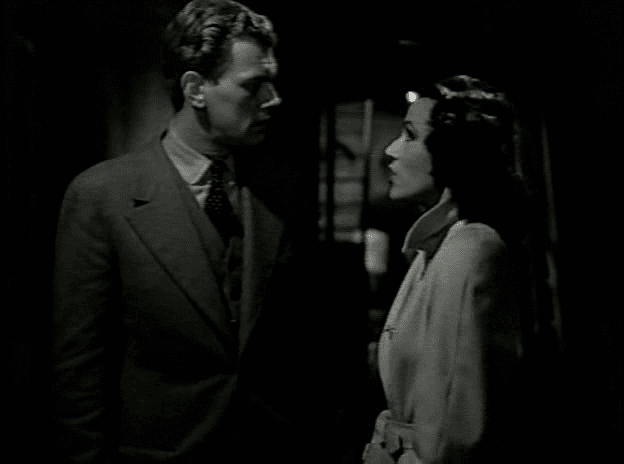
That night, as a storm rages, Graham runs into a hotel and asks for his wife in her room. When he calls her, she tells him to come right up. But he discovers that she is not alone, as Haller and Banat are waiting for him. Stephanie thinks that Haller is Bill Ridgely, a representative from her husband's company. When he tries to bolt, he finds Banat outside the door. She leaves them alone to discuss business while she joins Haki for a drink in the hotel bar. Haller asks her to keep Haki busy for a minute and leaves Banat in the room with Graham.

When Graham is reunited with his wife Stephanie (Ruth
Warrick), he finds Haller and Banat are also there.

But two maids come to change the linens, delaying Banat. Soon after the phone rings, Josette is calling from the lobby. She tells him that Gogo, who has been trying to make a deal with Graham for Josette's "services," is on his way up to the room. He arrives just as the maids are leaving. Banat shoots at him, sending him scurrying to the lobby for help. Graham uses the diversion to jump out the window onto the cornice of the building, where he is followed by Banat. Graham tries to escape through a hotel room, but out in the hall he sees Haller and goes back onto the ledge. At that moment, Haki appears on the ledge and shoots Haller. When Haki takes chase, Banat then wounds him and he falls back into a hotel room.

The heavy rain makes it hard for Banat to aim at Graham.

Graham chases after Banat who, even though blinded by the rain, keeps shooting at him, but misses. After emptying his pistol, Banat lies in wait for Graham, but falls to his death when the awning he grabs gives way under his weight.

Finally, safe in the hotel, Graham finishes writing the letter to his wife that he began on board the ship, and when Haki tells him that Stephanie is waiting for him upstairs, Graham tears up the now completed letter and leaves to join her.

For the most part, this is a fast-paced film with some interesting twists along the way. Like Graham, you never know who you can trust as everyone, including Haki, are suspect characters. While Muller and Banat want to kill him, Haki, it is rumored, is a ladies' man who might chase after Stephanie in Graham’s absence.
Joseph Cotton has a laid back acting style that seems to fit in well with Graham’s character. He’s the type that goes with the flow until that river nearly drowns him. But he never really loses his cool, which allows him to maneuver through his predicament.

On the opposite side of the ledger is Orson Welles’ portrayal of Haki. Even though the character really isn’t on the screen all that long, he certainly seems, through Welles’ presence alone, to dominate any scene he’s in. It’s also should come as no surprise that he also turns out to be a hero of sorts, killing one of the two assassins out to kill Graham.

Orson Welles' Haki isn't in many scenes, but still dominates the ones he is in.

Of these two, Jack Moss’ Peter Banat is the most terrifying. This is because he never says a word of dialogue in the film. Apparently, this was one of Moss’ requirements if he was going to play the role. A quick perusal of IMDb will show that this is his only role in a film, even though he would write, produce and direct films at different stages in his career. IMDb, as an example, lists him as an uncredited Associate Producer on Journey into Fear.

Delores Del Rio is not an actress that I’ve seen in many films, even though her career spanned Hollywood silent films through the Golden Age of Mexican cinema to appearances on Television shows. Mexican-born, Del Rio was one of the first Latin cross-over stars, considered by some to be a female equivalent of Rudolph Valentino. She successfully made the move to sound and made quite a splash in Bird of Paradise (1932), a pre-code film in which she swam in the nude.

Despite her credits and talents, she is in the film mostly because of her relationship with Orson Welles, whom she had met in 1940, when her marriage to Cedric Gibbons, MGM’s famous art director, was falling apart. While her relationship with Welles was fairly short-lived, she does make quite a presence in this film. She is as exotic as she is even-keeled as Josette, the cabaret performer who takes a liking to Graham while he’s on the run.

One of the oddest characters is Kopeikin played by Everett Sloan. I’m not sure what to make of him, not only does he insert himself into Graham’s life, but he seems to set up Graham like a pig to the slaughter. A rather bubbling man, he seems to do more harm than good, though he disappears from the film after Graham boards the boat with a gun Kopeikin supplies him no less. It’s hard to tell if he’s friend or foe, but he is really a little of both.

The film has a claustrophobic feel throughout, as it goes from room to room to boat to car, but it is really the rain scene at the end that really makes it worth watching. A fascinating set piece, the rain becomes as much a character as anyone else in the film, helping to save Graham’s life when it adversely effects Banat’s aim.
While the film may star Joseph Cotton, it still bears the stamp of Orson Welles. Even though he didn’t direct the film it still seems like a film meant to showcase his talents. Not that Norman Foster did a bad job directing the film, the shadow of Welles hangs over his shoulder.

Journey into Fear is not a bad film, though hardly great. Closer to a B-movie than Citizen Kane, perhaps without Welles in it, it might have succeeded better on that level.