Saturday, November 9, 2013

Stubs – Saboteur


Saboteur (1942) Starring: Priscilla Lane, Robert Cummings, Norman Lloyd, Otto Krueger, Dorothy Peterson. Directed by Alfred Hitchcock. Screenplay by Peter Viertel, Joan Harrison, Dorothy Parker. Produced by Frank Lloyd. Run Time: 108 minutes, Black and White. U.S., Spy Thriller Drama

By 1942, the U.S. was committed to World War II. Two weeks before Saboteur went into production, the Japanese had bombed Pearl Harbor, and while the movie sounds like an idea ripped from the headlines it wasn’t. Hitchcock, who seemed to be ahead of the atomic curve with Notorious (1946), pitched the idea for this film to David O. Selznick, the producer he was under contract to months before. While Selznick liked the idea well enough to have John Houseman keep an eye on the script, Val Lewton, Selznick’s story editor, passed on the screenplay. Hitchcock was then free to offer it to another studio.

In November, 1941, still before Pearl Harbor, Frank Lloyd and Jack Skirball bought the script and Hitchcock’s services for $20,000 and set it up through Universal Pictures. No doubt the fact that we were involved in World War II impacted the story and made it seem current to what was going on in the world and in the United States.
Saboteur should not be confused with another Hitchcock film, Sabotage, a 1936 British pre-war spy thriller that only hints at Nazi involvement in bombings. While I don't recall hearing the word Nazi in Saboteur we all know who is behind the sabotage in this film as well..

Barry Kane (Robert Cummings) and his best friend, Ken Mason (Virgil Summers), at work.
The film opens with Barry Kane (Robert Cummings) working at the Stuarts Aircraft Factory in Glendale, California outside of Los Angeles. His best friend at the plant is Ken Mason (Virgil Summers). One day on the way to lunch, a female co-worker catches Ken’s attention and he accidentally runs into Frank Fry (Norman Lloyd). Out of Fry’s pockets fall some envelopes and cash, including a $100 bill.

After Ken bumps into Frank Fry a lot of interesting things fall out of his pocket.
While everyone is eating, there is an act of sabotage at the plant. Barry and Ken run towards the fire. Fry is ahead of them and hands Barry a fire extinguisher. But Ken wants to get in on the action and Barry hands the extinguisher to him, but it is full of gasoline, as we later learn, and the fire quickly gets worse and engulfs and kills Ken.

Ken tries to fight flames with a fire extinguisher filled with gasoline.
After being questioned by the authorities, Barry goes to see Ken’s mother (Dorothy Peterson) and tries to comfort her. While he is next door getting brandy for her from a neighbor (Margaret Moffat), the police arrive looking for Barry. They tell her and she repeats to Barry, that they couldn’t find anyone named Fry working at the plant. While she lies about Barry being there, she does tell him to leave. He has to escape out the back door when the police return, based on the neighbor’s telling them she had just talked to him.

Barry gets a ride out of town with a truck driver (Murray Alper).
Barry escapes and next we see him, he is riding with a truck driver (Murray Alper). The trucker is happy for the company and seems to like Barry, driving him to an address he remembered seeing on an envelope he’d seen with Fry: Deep Springs Ranch in Springfield, California. But the ranch’s owner, Charles Tobin (Otto Kruger), says he doesn’t know anyone named Fry. He tells Barry that he’ll go call his neighbor to see if he knows Fry, but in reality, Tobin is calling the police. Barry is asked to watch Tobin’s granddaughter. They play catch with a ball before she hands Barry letters from Tobin’s pocket. Included is a telegram from Fry telling him he’s on his way to Soda City.

Charles Tobin (Otto Kruger) has Barry arrested when he comes to the Deep Springs Ranch looking for Fry.
While Tobin is the bad guy, Barry is the one who gets arrested. On his way to jail, the detectives’ car gets caught up in a traffic jam behind the truck driver Barry knows, who is changing a tire in the middle of a bridge. Seeing his opportunity, Barry leaps from the bridge into the river below. The police search for him, but with a little luck and the truck driver providing a diversion, Barry manages to escape.

Barry manages to escape police custody with a little help from his truck driver friend.
Barry gets caught in a rainstorm and seeks refuge in the home of blind composer Philip Martin (Vaughan Glaser). Philip may be blind, but he knows Barry is wearing handcuffs. He offers to feed him and let him stay through the storm. However, Barry’s sanctuary is invaded by the arrival of Martin's niece, New York billboard model Patricia Martin (Priscilla Lane). While Philip senses Barry's innocence, Pat does not.

Vaughan Glaser plays Philip Martin, a blind composer who lives alone in the forest.
Although her uncle asks her to take Barry to the local blacksmith shop to have his handcuffs removed, she attempts to turn him over to the police. Barry is then forced to kidnap Pat all the time protesting his innocence to her. In the middle of the California desert, Pat stops the car and gets out and threatens to flag down the first car that comes by. Barry uses the fan belt pulley of her car's generator to cut off his handcuffs. He grabs Pat and drives off but the fan belt breaks, causing the car to overheat.

Pat Martin (Priscilla Lane) tries to take Barry to the police rather than the blacksmith.
After night falls, the pair catches a ride from a passing circus troupe. On board are Bones (Pedro de Cordoba), the human skeleton; Major (Billy Curtis), a midget with a nasty demeanor; Tatiana (Marie Le Deux), the fat lady; Lorelei (Anita Bolster), the bearded lady; and Siamese twins (Jeanne and Lynn Romer). And while the performers recognize Barry as a fugitive from the law, they decide, in a split vote, to shield them from the police. Their belief in Barry also convinces Pat to trust him as well.

The circus freaks who hide Barry and Pat when they're on the run from the police.
The next morning, Barry and Pat are dropped off two miles from Soda City. What seems like an abandoned building in the ghost town turns out to be a staging area for an attack on the Hoover Dam. While they are there, two saboteurs, Freeman (Alan Baxter) and Neilson (Clem Bevans), arrive. Barry conceals Pat, but he is discovered by the saboteurs and convinces Freeman and Neilson that he is one of them. Freeman offers him safe passage to New York City. Barry also learns of their plans to sabotage the launching of a new U.S. Navy ship, the U.S.S. Alaska, at the Brooklyn shipyard, which Pat overhears.

All roads lead to Soda City.
But Barry is so convincing that Pat now believes he really is one of them. She escapes and goes to the authorities. However, the sheriff (Charles Halton) she talks to is sympathetic to Tobin’s cause.

When they arrive in New York, Freeman finds that the phone at their office has been disconnected, which is a signal that the police are on to them. Instead, he takes Barry to the mansion of society dowager Mrs. Henrietta Sutton (Alma Kruger). She is meeting with her co-conspirators while hosting a society ball downstairs. Barry finds Pat is already there. She had been betrayed by the corrupt sheriff, and had been held by the saboteurs as soon as she arrived back in New York. As Barry attempts to signal Pat to escape, Tobin then arrives and declares that his operation has been exposed by Pat's uncle and that Barry is not a part of their group.

As the conspirators decide what to do with the pair, a guest from the party interrupts and Barry and Pat sneak out. But the exits are blocked by their servants, including Robert (Ian Wolfe), who is definitely a part of the plans. Rather than leave, they enter Sutton’s ball trying to find sympathetic partygoers, but no one believes them. Even in plain sight, Pat gets snatched away when another dancer cuts in on them. In order to protect her, Barry is forced to turn himself over to Tobin.

Little do the attendees know that their hostess Mrs. Sutton (Alma Kruger) is really working for the other side.
Barry gives one of those patriotic speeches you hear in films made during the War. After his We’ll Win monologue, Tobin asks Robert if he can find a place for Barry to sleep and Robert saps Barry. He gets locked up in the cellar of the mansion, while Martin is kept in an office for a newsreel company at the Rockefeller Center. Pat manages to drop a note from her window, alerting cabbies on the street to her location. They notify the FBI, who rescue her off camera.

Pat gets ready to slip a note out the window in the room she's being kept.
Meanwhile, Barry sets off the fire alarm and automatic sprinklers at the Sutton mansion and manages to escape during the commotion. He hurries to the Brooklyn naval yard and uncovers the saboteurs, posing as newsreel photographers. In a really great scene, Barry recognizes Fry waiting in the back of the newsreel van to blow up the battleship. While Barry disrupts them, the ship does end up on its side in the water. The saboteurs then take Barry back to their skyscraper hideout, where the police, with Pat, await them.

In the confusion following the explosion, the saboteurs escape in the guise of a news van.
But Fry escapes into Radio City Music Hall where he shoots a spectator to create confusion, allowing him to escape. As he exits, Barry and Pat are leaving Rockefeller Center, Barry is in the FBI’s custody and cannot convince them to go after Fry. Seeing Fry getting into a taxi, Barry tells Pat to follow the spy. 

Fry uses a shootout on screen to help make his escape.
Fry boards a boat to Liberty Island and Pat does, too, even attracting his attention. When she sees him walk into the pedestal of the Statue of Liberty, she calls the FBI office. Finally convinced Fry is a person of interest, they tell her to keep him occupied until they can get there. While they rush to the monument with Barry in tow, Pat climbs to the crown of the statue and strikes up a conversation with Fry, stalling him long enough for Barry and the Feds to arrive.

Pat tries to strike up a conversation with Frank Fry inside the Statue of Liberty.
The film culminates in what is one of the greatest scenes that Hitchcock ever put on celluloid. Fry flees to the statue's torch and Barry follows. The saboteur slips off the crown and ends up clinging desperately to Lady Liberty’s giant palm. Barry climbs down to try to save him and grabs a hold of Fry’s coat sleeve while the Feds scramble to get a rope. But the stitching of Fry’s jacket sleeve starts to give way. One stitch at a time, then all at once. Fry is promising to clear Barry just before his sleeve comes off and he is sent plunging to his death.

The final sequence takes place on the torch of the Statue of Libarty.
Barry tries to save Frank Fry by getting a good hold on his jacket.
But the seam gives way...
... and Fry falls to his death.
Barry climbs back down the torch and embraces Pat.

Originally, Hitchcock envisioned Gary Cooper and Barbara Stanwyck in the title roles. But Cooper was unavailable and the new producers signed Priscilla Lane without any input from the director. Even though he was left with Universal contract players as his leads, he gets the most out of them. It’s hard to imagine Cooper doing a better job than Cummings did. While it’s a little hard to believe Lane as a model, especially how we think of models these days, she does a fine job as Pat Martin.

At the time the film was made, Lane was a bigger star than Cummings and even though her role is in support, she received top billing. In 1931 at 16 years old, Lane received a screen test at MGM along with then unknowns Katherine Hepburn and Margaret Sullivan. None of the three were offered contracts at the studio.

In 1932, Priscilla, along with her older sister Rosemary, began performing on the radio with orchestra leader Fred Waring. The two would sing and Priscilla became known as the comedienne of the two. In 1937, Warner Bros. bought out the sisters’ contract from Waring after they appeared with him in the film Varsity Show (1937).
Along with her sisters Rosemary and Lola, Priscilla appeared in Four Daughters (1938). Also in the cast was Claude Rains, Gale Hart and newcomer John Garfield. After that, she appeared in Brother Rat (1938), co-starring with Wayne Morris, but with a cast that included such newcomers as Ronald Reagan, Jane Wyman and Eddie Albert.

Priscilla Lane was not Hitchcock's first choice for the role of Pat Martin.
In 1939, she appeared opposite James Cagney and Humphrey Bogart in Roaring Twenties. That same year she appeared in a sequel to Four Daughters called Four Wives. In 1940, she appeared in another sequel, this to Brother Rat called Brother Rat and a Baby.

Even though her filming of Frank Capra’s Arsenic and Old Lace, opposite Cary Grant, caused her to join Saboteur after production had already began, the Capra film was held up until 1944, due to a contractual agreement not to distribute the film while the play it was based on was still running on Broadway. Lane retired from films in 1943 after completing The Meanest Man In the World. She did come back for only two more films, Fun on a Week-End (1947) and the film noir Bodyguard (1948) opposite Lawrence Tierney.

Her co-star, Robert Cummings, made his feature film debut in The Virginia Judge (1935) after having appeared on stage in The Ziegfeld Follies opposite Fanny Brice. Cummings didn’t achieve film stardom until Three Smart Girls Grow Up (1939) opposite Deanna Durbin. He played the lead role in Kings Row (1942) alongside Ronald Reagan, Claude Rains and Ann Sheridan. After appearing in Saboteur, Cummings would work with Hitchcock once again in Dial M for Murder (1954) with Ray Milland and Grace Kelly.

Robert Cummings as he appears in Saboteur. Robert (Ian Wolfe)  is on the left
Cummings also worked extensively in television, appearing in the first televised performance of Twelve Angry Men as Juror Number Eight, for which he received the Prime Time Emmy for Outstanding Lead Actor, in 1952. From 1955 until 1959 he starred in his own sitcom, The Bob Cummings Show (aka Love That Bob) as a former World War II pilot turned professional photographer. Ann B. Davis, who would go on to co-star in TV’s The Brady Bunch, appeared as Charmaine “Schultzy” Schultz, his assistant.

My admiration for Alfred Hitchcock goes without saying, though I have said it in other reviews. While we tend to lump all of his work under the label Hitchcock, his films may have certain characteristics, but are not all the same, nor tell the same story. Known for suspense, Hitchcock made films that defy that categorization like The Birds (1963) or even Psycho (1960). For every film that has a spectacular backdrop, like Mount Rushmore in North by Northwest (1959), there will be one that takes place in the front parlor of a London flat, Dial M for Murder. For a film like Saboteur, in which Barry makes a 3,000 mile trek to prove his innocence, there is one in which the protagonist hardly moves at all, Rear Window (1954).

Alfred Hitchcock makes his cameo appearance in Saboteur.
What makes Barry’s journey so interesting is that feeling you don’t know who to trust. Even Pat gets burned when she tells the local sheriff what’s going on in Soda City. Since he’s one of the fifth columnists of Nazi spies and saboteurs, she gets kidnapped when she returns to New York. Symbolically, it is a monument of the nation’s freedom (and gravity) that bring about real justice. Frank Fry is finally dealt punishment, giving his life for the life of Ken Mason.

Another interesting aspect of the story is the depiction of the fifth columnists as regular guys and family men. What they’re doing is their job, misguided as it may be, but they have other interests. Charles Tobin is a rich and debonair man who likes the finer things in life. Freeman talks to Barry about his children, another man tells Freeman, as he’s darning his own sock, that he’s promised to take his sister to the Philharmonic. There is even a bit of humor when one of her captors, the same one we saw darning his sock, brings Pat a milkshake and demands payment of 15 cents and gives her change from a quarter. (Note: I could not determine the character’s name or the name of the actor. If someone knows, I’d love to update the review and include.) Even though they’re working for the wrong side, the saboteurs are still presented as three-dimensional people.

Would love to know the name of the guy seated darning his own socks.
And while this film ends big, dangling from the torch of the Statute of Liberty, it is really a personal struggle of one man trying against all odds to prove his innocence. The authorities, like the FBI, want to arrest him and the supposed upstanding citizens, the rancher and the dowager, are the ones he’s fighting against. His only friends are lonely truck drivers, blind composers living in solitude or sideshow freaks. Barry stands or falls depending on how strangers read him. And even while we read the film as proving Barry’s innocence, since Hitchcock ends the story before that’s resolved, we don’t know if anyone else on the torch heard Fry’s whispered promise that he would set the record about Barry’s involvement straight.

Modern audiences should not view Saboteur as simply a war film and a relic of the past. Obviously, it is told against the backdrop of World War II and the sabotage is aimed at U.S. military readiness, but there really is more going on here than that. Saboteur is the search for truth and justice. While it ends in a spectacular way, it is still a personal journey, of one everyman against the world, so to speak. Barry doesn’t lose sight of who he is, even though everyone else around him seems to.

Watch it for the ending, but enjoy Saboteur for the journey getting there.

Friday, November 8, 2013

Thor: The Dark World - An Acceptable Sequel


Thor: The Dark World (2013) Starring: Chris Hemsworth, Natalie Portman, Tom Hiddleston, Anthony Hopkins, Stellan Skarsgard, Idris Elba. Directed by Alan Taylor. Produced by Kevin Feige. Screenplay by Christopher Yost, Christopher Markus, Stephen McFeely. Based on the Marvel comic by Stan Lee, Larry Leiber and Jack Kirby.  Run Time: 112 minutes. U.S. Color. Science Fiction, Action, Adventure

I want to go on record as saying that I have been following the Marvel Cinematic Universe even before we started calling it that. I regrettably saw the first Hulk film (which I know is not part of it), but I’ve been watching these films all along and usually going opening weekends. And I did the same thing this weekend, when Thor: The Dark World opened.

During the first series of the MCU, those films leading up and culminating with Marvel’s The Avengers (2012), the one I was most concerned about, after The Incredible Hulk (2008), was the original Thor (2011). I am not a fan boy when it comes to the comics and I really had my concerns going into that one. The first review on Trophy Unlocked called it The God of Acceptable and in my second opinion, written after watching the film again in prep for The Avengers, I called it a must see, but also referred to it as a tweener film, as in it gets us from Iron Man to Captain America. Not great, but necessary.

I really want to like Thor: The Dark World more than I do. I think the film is well cast and well-acted. The special effects are good, but I wouldn’t say they’re major improvements over last time, and the story is okay, but not great. I will not go into too much detail about the plot of the film, since it is just in the theaters. There is humor, there are twists, there is action and unfortunately some head scratching questions when all is said and done. But isn’t that why we have sequels, and Thor will return, we are promised that.

The film revolves around a new villain, Malekith (Christopher Eccleston), a dark elf who is out to change the universe, Asgard and Earth included, in his own image with the help of an ancient power and Convergence of the nine worlds. Naturally, Thor (Chris Hemsworth) is just about all that separates him from reaching his goal. But Thor needs a major assist from Jane Foster (Natalie Portman), Dr. Erik Selvig (Stellan Skarsgard) and even Loki (Tom Hiddleston).

Thor needs Loki's (Tom Hiddleston) help in Thor: The Dark World.
I really enjoy Chris Hemsworth’s portrayal of the character. He was good in Thor, but I liked him better in The Avengers, but I liked most of the characters better in The Avengers, so there you have it.

Chris Hemsworth returns as Thor.
Tom Hiddleston makes for a great Loki. His portrayal of Thor’s adopted brother is always a good mix of humor and evil. You never know what Loki is thinking and if he can be trusted. Spoiler: He can’t.

Stellan Skarsgard plays, as he has in the past several films, Dr. Erik Selvig, a scientist who has been with us since the original Thor. By now Dr. Selvig is a bit damaged, but his oddities are played for laughs by Skarsgard. His co-scientist, Jane Foster, is Thor’s love interest and I must say Natalie Portman has grown on me in this role. As has Kat “Two Broke Girls” Dennings, who once again plays Foster’s unpaid intern Darcy Lewis. Idris Elba returns as Heimdall, the gatekeeper. It feels like his part is beefed up slightly from the last one. Also back, but in more diminished roles, are the Warriors Three: Volstagg (Ray Stevenson), Hogun (Tadanobu Asano) and Fandrat (Zachary Levi) and Lady Sif (Jaimie Alexander).

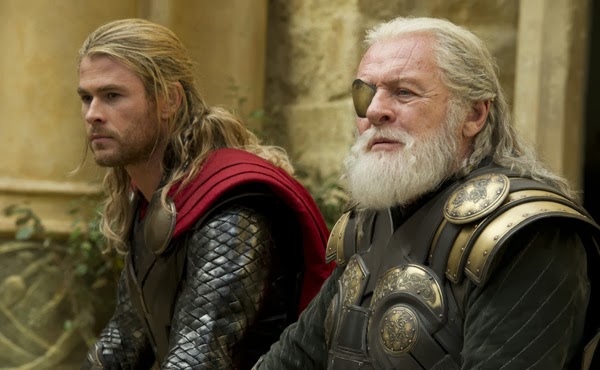
Anthony Hopkins as Odin, the King of Asgard, gives the film a certain gravitas. He is not someone you would expect to see in a comic-book based movie, but neither was Ben Kingsley in Iron Man 3. It’s not as if these actors are too good to be in such films, it’s just that you would not expect them to be. But they are following in the footsteps of Sir Alec Guinness who appeared in Star Wars (1977), so there really is nothing new about their appearances.
Anthony Hopkins is once again Odin, the King of Asgard and Thor's father.
Now after all the pluses, I have to admit that while I liked Thor: The Dark World, I didn’t really love it. Every so often I found myself thinking back to those old sword-and-sandal films that would prompt me to change the channel when I saw them on TV in my youth. Part of it has to do with the source material and is unavoidable, but that’s part of the reason I was concerned about the first film. Sadly that concern doesn’t go away with Thor 2.

It’s really hard to address the directing in one of these films, as I’m not sure how much of the story comes from source materials, the screenplay and the director’s head. For me there is almost a little too much story in the film, too many characters I’m supposed to remember caring about in the first film. And I won’t get into great detail about it, but there is a scene in which the film manipulates the audience, which I think is a cheap trick, especially when it’s not really necessary to lead us astray.

The Asgard universe seems to be more advanced, but at the same time more backwards than our own. As an example, they don’t have anything like cell phones for an advanced race, relying instead on the face-to-face meeting, even when it is not expedient. Can you really be considered a God if you don’t have a smartphone?

Advanced weaponry exists side by side with armor; an odd mix, and while it might work well in a comic book, it seems odd when mashed up against our modern day. Magic and black hole producing grenades; if you had one would you really need the other?

And we have our own pseudo-science that supposedly works, but is never explained. And maybe that’s true of the movie as a whole. There is a lot that seems to go without explanation. And while I can look the other way for a while, eventually you have to be able to watch the movie with both eyes wide open.

I’m not really sure how necessary Thor: The Dark World really is in the overall MCU. It is one of those films I felt I needed to see, but only to avoid spoilers coming from loose lips, rather than a film I felt needed to be made. However, if you do go, and you know you will, be sure to stay through all the credits, that wall of names at the end of the film that so many people walk out on. In typical MCU fashion, there are clues to further films in the series and you’re going to hate yourself if you miss those.

Saturday, November 2, 2013

Stubs - Them!


Them! (1954) Starring: James Whitmore, Edmund Gwenn, Joan Weldon, James Arness. Directed by Gordon Douglas. Screenplay by Ted Sherdeman, Russell Hughes. Story by George Worthing Yates. Produced by David Weisbart. Run Time: 94. Black and White. U.S. Science Fiction, Horror.

This will definitely age me, but I originally saw Them! when I was a kid on television. And this was back in the days before cable, satellite and 200 plus channels of choice. Back when there were only three networks, not counting PBS, and one independent TV station in Dallas, which is where I’m from. I remember liking the film, being a little grossed out by the big ants but still liking it. This was before I knew who James Whitmore was or that James Arness was Matt Dillon on Gunsmoke or had been The Thing From Another World (1951).

Originally conceived as a color, widescreen, 3D spectacular, the film ended up being black and white and widescreen. The color tests proved to be disappointing and Warner Bros.’ “All Media” 3-D camera malfunctioned. The only color in the film are the blue and red titles and even though the film was not shot in 3-D, some of the camera set ups still remain.

This would have probably looked awesome in 3D.
While following up on an unspecified report, New Mexico State Police troopers Ben Peterson (James Whitmore) and Ed Blackburn (Chris Drake) discover a little girl (Sandy Descher) in shock, wandering the desert near Alamogordo. Following up on the report of an abandoned car and trailer, the two troopers find it deserted and the side of the trailer ripped open from the outside. They do find a strange print in the sand and call for an ambulance and crime scene investigators. A cement casting is made of the print. Before the ambulance leaves, with an attendant (William Schallert) watching the little girl, a strange sound echoes out of the desert wind. The little girl, though no one notices, responds to the sound.

Troopers Blackburn and Peterson check out the Ellinson trailer.
Peterson and Blackburn go to “Gramps” Johnson’s General Store further down the highway to see if he knows anything about the missing family. Like the trailer, his store has been torn apart from outside. But no money has been taken from the cash register. The only odd damage is a barrel of sugar that has been smashed open. Peterson finds Gramps’ Winchester rifle has been fired, but also twisted out of shape. They find Gramps’ dead body in a basement. It is later determined that he could have died from a multitude of wounds, including a broken neck and back, a skull fracture, crushed abdomen and what Coroner Putnam (Joe Forte) confirms is “enough formic acid in his body to kill 20 men.”

Peterson leaves Blackburn at the store to wait for the crime scene investigators, while he goes to check on the little girl. But no sooner has Peterson driven off then Blackburn hears the same strange sound. When he goes outside, we know he’s doomed. Off-camera shots are fired, the sound gets closer and we can hear Blackburn scream in terror.

Because the owner of the trailer was an FBI agent named Ellinson, another FBI agent, Robert Graham (James Arness), is dispatched from the office in Alamogordo. (More than likely he was the office in Alamogordo). He sends the plaster cast of the oddly shaped footprint to his Washington, D.C. headquarters. In return, Dr. Harold Medford (Edmund Gwenn) and his daughter, Dr. Pat Medford (Joan Weldon), a team of entomologists, are dispatched from the Department of Agriculture.

The Medfords are taken to see the Ellinson girl in the hospital. He manages to bring her out of her catatonic state by exposing her to formic acid fumes. She screams "Them! Them!" Next Drs. Medford are taken the site where the trailer had been. Pat goes out to search from more prints and encounters a giant, eight-foot long foraging ant. The lawmen fire, but don’t do any real damage until they take senior Medford’s advice and shoot the ant’s antennae. Peterson manages to empty a Thompson submachine gun into the ant, killing it.

There's nothing like the smell of formic acid in the morning.
Only later does senior Medford reveal his catastrophic theory that the giant ants were created by exposure to the first atomic blast nine years before at nearby White Sands. And if they aren’t stopped, mankind might get wiped off the earth by the very aggressive and powerful mutants.

If this ever happens to you, remember to shoot at their antennae.
Helicopters searching the desert find a nest. Phosphorus is fired at the opening to keep the ants inside the nest and poison gas bombs are tossed in to kill the ants inside. Graham, Peterson and Pat Medford go into the nest to confirm that all the ants have been killed. But Pat finds evidence that two of the eggs have hatched and that two queens have escaped to potentially establish new colonies. In an effort to avoid a general panic, the government covertly investigates any reports of unusual activity, even sightings of "flying saucers."

Ant with human rib cage in its mandible. Eew!
One report, taken by a sergeant (Leonard Nimoy), has Pat Medford and Graham fly to Brownsville, Texas, where a pilot (Fess Parker) has been put into a state psychiatric hospital for making his report. He tells the two that while he was flying into Brownsville he saw three flying saucers shaped like ants, heading west. Even though Graham believes him, he tells the attending physician (Marshall Bradford) to keep the pilot locked away until the government says he’s cured. (What do you bet he’d still be there today if that was real?)

Pilot (Fess Parker) tells Dr. Pat Medford and Agent Graham what he saw in the sky.
The Coast Guard receives a Morse Code message saying a giant queen has hatched her brood in the hold of a freighter. We see giant ants attack the ship's crew and are told only a few survivors escape to be rescued. The freighter is later sunk by the U. S. Navy. Another report leads Graham and Peterson to a rail yard in Los Angeles with a smashed boxcar missing 40 tons cargo of sugar. The watchman (Dub Taylor) is brought in for questioning, but let go.

One queen starts a colony on board a freighter.
The body of a mutilated man is found and connected to the report of a missing father and his two sons, Graham and Peterson, to Jensen (Olin Howland), an alcoholic patient in a Los Angeles hospital "drunk tank". He reveals that he's been seeing giant ants outside his window for the past 5 months. The room overlooks the Los Angeles River. When they go down to investigate, they find a broken model airplane. A call to Mrs. Lodge (Mary Ann Hokanson) confirms that the father was flying a model airplane with his sons in the river basin.

Given this significant threat, the U. S. Army declares martial law and a curfew for Los Angeles; more troops are assigned to find and then assault the new nest in the storm drains under the city.

Peterson finds the two missing boys alive deep inside the drain system, but they are trapped by the ants' nest. He calls for reinforcements and goes in alone to rescue the boys, finally getting them to safety. Before he can escape, he is attacked by a giant ant. Graham arrives too late with the reinforcements and Peterson dies. But the troops fight off the ants just before a cave-in temporarily cuts off Graham. Several ants charge him, and he is able to hold them off long enough for the other troops to tunnel through and rescue him. The queen and her young "princess" hatchlings are quickly discovered and then destroyed using flamethrowers.

The last thing the ants see in Them!
The film ends with Graham asking if these ants were a result of the first atomic tests, what else might there be from the subsequent tests? This leads the senior Medford to warn: "When man entered the atomic age, he opened the door to a new world. What we may eventually find in that new world, no one can predict."

With the atomic age upon us and the Cold War heating up, the effects of radiation were a real concern to movie-going audiences. Them! takes that fear and tells a compelling story based on it. There are some things that don’t make sense along the way, like why a New Mexico State trooper would be leading Army commandos against a nest of giant ants in the sewers of Los Angeles? But part of the low budget charm in these kinds of films is the cast gets used throughout, in situations, say shooting bazookas that you’d think there’d be specialists to do. 

Otherwise the film is fairly fast paced, suspenseful and if you only know what they tell you in the movie, credible.

Considering the type of movie this is, there are many solid actors in the film, including several who would go on to find fame and fortune on television. This was a studio picture, Warner Bros., so it is not surprising they were using people they probably already had under contract. Chief among the actors who would go onto to bigger things on smaller screens was James Arness, who had graduated from playing The Thing From Another World to playing FBI agent Graham. The next year, Arness would start playing his best known and longest running role, Matt Dillon on TV’s Gunsmoke (1955 to 1975).

But in addition to Arness, William Schallert, who had a small role as an ambulance attendant, would go on to play Patty Lane’s father Martin on The Patty Duke Show (1963 to 1966). And Leonard Nimoy, who was uncredited in Them! would go on to play Mr. Spock on Star Trek (1966 to 1969) and in subsequent related films.

Leonard Nimoy of Star Trek fame had a bit part in Them!

While James Whitmore would also have his own TV series, The Law and Mr. Jones (1960-61), he is better known for his movie roles, including Gus Minissi in The Asphalt Jungle (1950) and Harry Truman in Give ‘Em Hell, Harry (1975). Whitmore was twice nominated for Academy Awards; once for Best Supporting Actor for his role in Battleground (1949) and once for Best Actor of Give ‘Em Hell, Harry.

Joan Weldon, who played the eye candy 1950’s horror films seemed to require, had a rather short career in films. She has only appeared in very few films and television shows from 1953 to 1958. Her role as Dr. Pat Medford is by far her best known part. She returned to her career as a performer in road company productions and retired in 1980.

Edmund Gwenn and Joan Weldon play father/daughter entomologists in Them!

The actor who played her father, Edmund Gwenn, on the other hand had a very long career in films, appearing in over 80 features from silents on. A cousin of actor Cecil Kellaway (The Postman Always Rings Twice), Gwenn may be best remembered for his role as Santa Claus in Miracle on 34th Street (1947), for which he won the Academy Award for Best Supporting Actor. He won a second Academy Award for his role in Mister 880 (1950).

Gwenn also appeared in two Hitchcock films, as the cockney assassin in Foreign Correspondent (1940) and later in The Trouble With Harry (1955). A British born actor who moved to Hollywood, he appeared as Katherine Hepburn’s father in Sylvia Scarlett (1935). Adept at playing both comedy and dramatic roles, Gwenn’s last British film was Cheer Boys Cheer (1939), which is considered to be the prototype for Ealing Comedies, which would be made by the Ealing studio after World War II.

Them! was the first of several films having to do with irradiated beasts. Godzilla (1954) would be roused by nuclear testing at the Bikini Islands, giant spiders would threaten mankind in World Without End (1956) and grasshoppers would mutate into bus-sized abominations after coming into contact with radioactive fertilizers in Beginning of the End (1957) to name a few.

Ironically, it is the ants in Them! that are perhaps the most disappointing aspects. The film would go on to to be nominated for Best Special Effects, which must say something about the state of special effects in the mid-1950’s. I’ve learned that the ants used in the movie required a team of operators to move and that shows. These ants don’t scurry, they lumber and look more clumsy than menacing.

This is actually a good shot of one of the ants from Them!

I read one article that claimed Them! was Warner Bros.' highest-grossing film of the year and I’ve also read that it was the 51st highest grossing film of the year, bringing in $2.2 million in box-office rentals. Either Warners had a really bad year or this Slate magazine story is wrong.

Them!, no matter what it made at the box-office, is still a fun diversion and very much worth watching. If you’re looking for the best radiated mutant insect monster movie to watch, look no further.

Them! is available as part of a collection at the WB Shop:

Free Shipping on All Orders Over $50!

Friday, November 1, 2013

Metalocalypse: The Doomstar Requiem - A Klok Opera


Since first listening to Metallica in high school, my experience with the Heavy Metal genre of music has expanded greatly to include the plethora of sub-genres in some form or another. One of the flavors of metal that I’ve come to love is Death Metal and a number of its permutations, one being Melodic Death Metal (think Death Metal crossed with the melodic elements of Iron Maiden). The interest in this particular sub-genre came about a couple of years ago when I finally discovered Dethklok, a band promoted by the use of its music and associated imagery via the Metalocalypse cartoon, created by Brendon Small and Tommy Blacha, on Adult Swim. I have since watched all four seasons of Metalocalypse and own Dethalbums I-III, both of which are among my favorites in their respective mediums. On October 27 of this year, Adult Swim aired a one-hour special for the cartoon called The Doomstar Requiem - A Klok Opera (sometimes shortened as simply The Doomstar Requiem), a rock opera which counts as a movie for the purposes of this blog (as alluded to by co-creator Brendon Small’s original plans for the show). Interestingly enough, I was completely unaware of the special until my TiVo began recording it on the night it aired, but, nevertheless, I watched it at the earliest opportunity and found myself impressed by the end result in more ways than one.

Spoiler Note: The Doomstar Requiem takes place directly after the events of the Metalocalypse Season 4 finale “Church of the Black Klok”. As such, there will be unmarked spoilers regarding its placement in continuity and it is suggested that you have at least seen “Church of the Black Klok” before continuing. Don’t say I didn’t warn you.

As per the events of “Church of the Black Klok”, Dethklok guitarist Toki Wartooth (Mike Keneally) and band producer Abigail Remeltindrinc (Raya Yarbrough) have been kidnapped by Magnus Hammersmith (Brendon Small), a former Dethklok guitarist who seeks revenge for being kicked out of the band. At the same time, a star known as the Doomstar has been born in the sky and the only way to harness its power is for Dethklok to reunite by locating and rescuing Toki; according to the prophecies of the Church of the Black Klok, someone is also supposed to die in the process. However, remaining Dethklok members Skwisgaar Skwigelf (Brendon Small), William Murderface (Brendon Small), Pickles (Brendon Small) and Nathan Explosion (Brendon Small) are too busy partying to care about the safety of their kidnapped brethren. With continued failure by the band’s manager and CFO, Charles Foster Offdensen (Brendon Small), to locate Toki, he and Church of the Black Klok leader Ishnifus Meaddle (Brendon Small) try to convince the band of the importance of their missing member. As this happens, Toki tries to make the best of his situation by reminiscing about the time he joined Dethklok.

The members of Dethklok (Left to Right: Willaim Murderface, Skwisgaar Skwigelf,
Nathan Explosion, Pickles the Drummer, Toki Wartooth)

While some may not care so much about the plot of The Doomstar Requiem because of the music, more on that later, I felt that the story of this rock opera was actually executed pretty well. There is quite a bit of setup and recapping going on at the beginning, including some of the band members introducing themselves, but I found this necessary as it not only allows The Doomstar Requiem to be a stand-alone feature, but also lets the audio-only CD version function entirely on its own with a self-contained plot. Regarding the rest of the special, it felt afterwards as though they had made the plot of what would normally be a double-length episode (Metalocalypse episodes are usually 11 minutes long) be extended to fit a 47-minute (quadruple length?) one. If one were to look solely at the plot and nothing else, it might seem like the special contains quite a bit of padding, though this didn’t matter to me because a rock opera requires that they use songs, and only songs, to move the plot and describe the emotions of the characters.

With that said, I found the story, which is also to say the music, to be very well-written. Not only did the opening set the stage for what was to come, but questions introduced are answered in a way that is satisfactory for longtime viewers and help tie up the loose ends of the plot. As I watched and listened to each song, written and composed by Brendon Small plus an accompanying 50 piece orchestra composed by Bear McCreary, I felt a dynamic range of emotion. I found myself genuinely moved one moment (such as with the song “Abigail’s Lullaby”) and then laughing the next, with some major revelations serving to act as both a major source of suspense and shock. There was absolutely nothing that didn’t keep me watching until the very end in the hope that Dethklok could accomplish their goal before it was too late. As a bonus for those that are watching the special, there is a cliffhanger created during the credits which seems to set up a potential fifth season of Metalocalypse, which I am now highly anticipating. However, I must say that even without taking other parts of the canon into account, there still remain some lingering questions brought up by the special, such as what the Tribunal will do next, so if you choose to only experience this special, you will find yourself confused.

On its own, the music is also some of the best that Brendon Small has ever written; it is also performed by Dethklok’s studio lineup, which includes Gene Hoglan on drums and Bryan Beller on bass while Brendon Small does everything else. The number of different styles present, including a couple of ballads and a Thriller parody, does nothing to detract from my enjoyment of The Doomstar Requiem, since each new track flows very well into the next for seamless storytelling. There is a good balance of both dark and upbeat tones to keep things interesting and break up what would otherwise be a completely serious special; this is a good sign that comedy is still an important element to Metalocalypse. One of my favorite moments in fact is watching a two-minute guitar duel between Toki and Skwisgaar in the past, which contains both some epic shredding by Brendon Small and a small section of Baroque style guitar work; this song, known as “The Duel”, seems to perfectly encapsulate what The Doomstar Requiem is like: A serious project presented with a fine comedic edge.

There are also some guest vocals from Jack Black and George “Corpsegrinder” Fisher (lead singer of Cannibal Corpse), the latter of whom is the Metal Masked Assassin, among others. This introduces some good variety into the vocals, though Brendon Small did show an incredible ability to distinctly voice 13 different characters on his own.

The Metal Masked Assassin, voiced by George "Corpsegrinder" Fisher.

Visually, The Doomstar Requiem contains the best animation I have seen from Metalocalypse. The animators at Titmouse still have it in them, with dynamic visuals and a great range from a mostly dark color palette (though when the colors get super bright such as during “Partying Around the World” it’s played heavily for laughs). When Titmouse isn’t showing off how well they can synchronize virtual guitar playing with what’s actually being played, they manage to animate the story in such a way that if someone were unable to understand the lyrics for one reason or another, they could still follow along with the story (I have yet to find what happens when the situation is reversed), so I never found myself lost by what had happened.

This is even more metal in context.

When all is said and done, The Doomstar Requiem is an amazing rock opera. Though some may find fault with the amount of exposition needed to make this production a stand-alone effort, I felt impressed by what I had seen. With some of the best visuals and music that Metalocalypse has to offer, fans of the show who have been anxiously awaiting a continuation of the show after 15 months may find themselves pleased. Those who end up enjoying the special regardless of any flaws may also find themselves in the same boat as me, waiting (im)patiently for the possibility of a fifth season to be fulfilled thanks to the still-lingering questions the mythology of the show has created. In any case, I applaud Brendon Small’s efforts and can’t wait to see what he has in store next for Dethklok.