Side Street (1949) Starring: Farley Granger, Cathy O'Donnell, James Craig, Jean Hagen. Directed by Anthony Mann. Screenplay by Sydney Boehm. Produced by Sam Zimbalist. Run Time: 83 minutes. USA Black and White. Film Noir, Drama.
Hollywood is always looking for great screen pairings. Many of them have become legendary, like Kathrine Hepburn and Spencer Tracy, Humphrey Bogart and Lauren Bacall; Fred Astaire and Ginger Rogers to name a few. Add to that the names Farley Granger and Cathy O’Donnell. At least that’s what MGM hoped for when they paired these two actors together after they’re first appearance on screen in RKO’s They Live By Night (1948). While that film lost money, the reviews were positive, so a repairing seemed in order. Each was under contract to a different independent film producer, Cathy O'Donnell to David O. Selznick and Farley Granger to Samuel Goldwyn, but borrowing actors for a particular film was part of the business.
With a budget of nearly $1 million, the film went into production on April 21, 1949 using locations in New York City including Central Park, Stuyvesant Town, Battery Park, the Bellvue Hospital morgue, the Polyclinic maternity ward, Wall Street, Bowling Green Park, the Fulton Fish Market, the Queensboro Bridge and a Greenwich Village nightclub. Production ended in mid-June. According to an article in the New York Times, filming of a scene in which a taxicab is being chased through the Wall Street area ran into some difficulties when the taxicab that was supposed to hit a curb and flip onto its side in front of the J. P. Morgan Building failed to do so after repeated attempts. Eventually, they would get it right.
 |
| New York City is a character in Side Street as well as the setting. |
There is narration at the beginning of Side Street. While the voice is not identified, we will later learn who it is. He introduces the story a la The Naked City (1948). It will appear occasionally throughout, but here is trying to set the tone of the film. Through it we are introduced to the story of Joe (Farley Granger) and Ellen Norson (Cathy O’Donnell), a young married couple living with her parents, but expecting their own baby in a matter of days. Joe, who had previously had and lost a gas station business, is only able to get a job as a part-time postal carrier. But Joe still has big dreams, telling Charlie (Robert Malcolm), a patrolman he knows on his route, that he wishes he could buy her a fur coat and take her on a trip to Europe.
 |
| Joe (Farley Granger) confides in Charlie (Robert Malcolm), a patrolman he knows from his route. |
Meanwhile, Emil Lorrison (Paul Harvey), a wealthy broker, goes to the bank to withdraw $30,000 in hundred-dollar bills. Chief teller Harold Simpsen (Whit Bissell) serves him.
Lucille Colner (Adele Jergens), Emil’s mistress, is on the phone with Victor Backett (Edmund Ryan) putting the final touches on their plans. In his office is George Garsell (James Craig), who is shaving with an electric razor and listening in. She needs to hear that Victor loves her and she tells him that she wants to get away afterwards. Victor throws out ideas like going to Cuba, which was still an option back then, to get her to complete the job. When they’re off the phone, George jokes that wherever she goes will be by way of the East River.
That is the day that Joe enters to deliver mail, temporarily interrupting the planning. He accidentally brushes two one-hundred-dollar bills to the floor. Out of politeness, he bends down to pick them up, but he’s stopped by George, who picks up the bills, puts them in an accordion file and puts them in a filing cabinet. He tells Joe to mind his own business, but Joe can’t stop thinking about it.
Later, with George in the other room as insurance, Emil shows up right on time. He tries to tell Lucille that he could only raise $15,000. But when she suggests she could go to his wife for the rest, Emil produces the money in exchange for the photos and negatives. George throws the envelope out of the room he’s in and holds a gun on Emil while he paws through the envelope for the evidence of his affair with Lucille.
Next time we see Lucille, her dead body is discovered floating in the East River. She has been strangled.
 |
| Joe steals what he thinks is an accordion file with $200 in it. |
When Joe gets home, he’s reminded about how much he could use $200. Ellen is about to pop and he doesn’t want her to have to give birth in a Ward, but to do that, he needs money. Thinking the money will be the answer to his problems, Joe breaks into the now locked file cabinet when he finds the office is empty and Backett is away at court. Using an ax, he breaks the lock and steals the accordion file that he saw the money put in. He stuffs it into his mailbag and flees.
 |
| When Joe finally looks into the file he finds there is $30,000, not $200 in there. |
On the roof of a building on his route, Joe stops to dig out the money from the file, but instead of $200, there is $30,000. He takes the money and stuffs the accordion file into a crevice he finds in a brick wall. He takes the money home and sneaks it into his bedroom. Fashioning a crude box, he puts all but $200 of the money into the box. When Ellen gets home, Joe pretends that the money he gives her is because he’s found a new job from an Army buddy of his. But he needs to leave that night for Schenectady so he can learn the business. He promises to be back before she has the baby.
 |
| Joe lies to his pregnant wife Ellen (Cathy O’Donnell) that he has a new job. |
He takes the money to Nick Drumman (Ed Max), a bartender he knows, but he tells him the box is a nightgown he’s bought for his wife and asks Nick to hold it for him so she doesn’t find it in the apartment. Nick puts it in a cabinet. Joe then checks into a seedy hotel where he spends a couple of days that he’s supposed to be out of town.
 |
| Joe trusts bartender Nick (Ed Max) to watch after his new found fortune. |
In the meantime, Capt. Walter Anderson (Paul Kelly) of the New York Police Department investigates Lucille Colner’s murder. A search of her possessions finds a “love diary” and they start to interview men whose names appear, including both Lorrison and Backett.
After a few days, he returns home, where a neighbor asks him what his wife had, a boy or a girl? He rushes down to the hospital and finds that his wife is in a Ward, not a private room. He gets to see his child for the first time but is rushed out of the Ward by the head Nurse, Williams (Sarah Selby).
 |
| When Joe goes back to Nick to retrieve his money, he finds out that he's sold the bar and moved away. |
Feeling remorse about the theft, Joe goes back to Backett’s office under the guise that he’s running an errand for a friend. Not only does Backett tell him he has no idea what $30,000 Joe’s talking about, but Joe also notices the file cabinet is gone from the office. Joe, of course, tells Backett where he lives and that he doesn’t have the money on him, but knows where it is. He’s still in the office when George returns. Backett leaves sort of bewildered.
 |
| When Joe tries to return the money, Victor Backett (Edmund Ryan) acts like he has no idea what he's talking about. |
When Backett tells George about Joe’s errand, he warns him that the money will lead police to Lucille’s murderer. Fearing a trap, Backett sends George to follow him to retrieve the money. Joe goes to Nick’s bar to retrieve his package, but in the intervening days, Nick has sold the bar. The new owners are friendly, though at first, they claim not to have seen a package. But they look a little harder and find a package the same size and shape as the one Joe had left in Nick’s care. But when he examines the package, he finds instead of the money, there is a nightgown inside.
When Joe asks about Nick’s address, the new owner gives him the one they have for him. Unbeknownst to Joe, another man, whom we learn was George, has already been there for the same information. The address is a small funeral home, where Joe is waited on by Nick’s young nephew Tommy Drummon, Jr. (Peter De Bear). For two bits he gives Joe Nick’s address. Again, Joe doesn’t know that he’s the second man to have paid the fee.
By the time Joe gets to Nick’s apartment, he finds that he’s been killed, strangled, just like Lucille had been. He finds one of the currency wrappers on the floor and figures out that the money was there and has been taken. The phone rings out in the hall, and when neighbors knock on the door, they believe he’s home since they saw a man go into his apartment. Joe manages to escape out the window, but now Anderson is looking for him, too.
The police know they have two murders, both strangled, but they believe they might have been done by two different men.
Joe goes back to the hospital and breaks in after hours. There he confesses to Ellen what he’d done. She advises him to go to the police. But Joe doesn’t think he can and flees.
Instead of going to the police Joe goes on the run, but while still trying to find out where the money came from. And his attempts to track down the source of the money only makes him look worse to the cops, as he looks guilty by association to the cops like Anderson who are looking for him. After he tracks down Harold Simpsen, he is only steps ahead of the police.
 |
| Joe tracks down Chief cashier Harold Simpsen (Whit Bissell). |
He goes back to the accordion file and looks for anything that will help him. He finds a photo of Harriette Sinton (Jean Hagen) and manages to track her down. She’s a singer in a Greenwich Village bar. Joe pretends to be someone else and tells her he’s trying to get in touch with his old friend George, her ex-boyfriend. He buys her drinks and she flirts. When she goes to get ready, she catches him going through her purse.
 |
| Joe tracks down Harriette Sinton (Jean Hagen) at a Greenwich Village nightclub. |
They take a taxi. Joe thinks they’re going back to her place, but instead, it turns out to be George’s. Along with cab driver Larry Giff (Harry Bellaver), George knocks Joe out and plans to kill him. Giff’s enthusiasm for the activity starts to wane.
 |
| George Garsell (James Craig) knocks Joe out. Larry Giff (Harry Bellaver), a taxi driver, helps him. |
Harriette thinks her bringing Joe to George will restart their relationship and George appears to go along. But in the end, she knows too much, so George does what he always does and strangles her to death, dumping her body in the cab. Joe is taken down to the cab as well, with the plan to kill him and dump both bodies in the river.
 |
| Larry and George take Joe for a ride. |
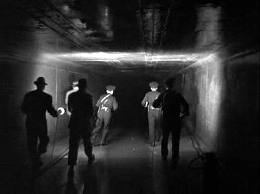
Meanwhile, Anderson has started to put things together. After interviewing and detaining Backett, he gets a tip and heads out to George’s apartment. A chase ensues through the very deserted streets of Manhattan. But Giff wants out. George lets him park the cab and get out, but while Giff is fleeing, George shoots and kills him. Then holding a gun on Joe, makes him drive the cab.
 |
| Capt. Walter Anderson (Paul Kelly) finally gets around to Backett and brings him in for questioning. |
Joe’s heart isn’t really in trying to outrun the police to assist his would-be killer, so while he drives fast, he also manages to overturn the cab (see above). As the police surround the cab, George gets out and tries to run away, only to be shot and killed himself.
 |
| Joe manages to turn the cab over, ending the pursuit. |
Ellen, who has been down at police headquarters, arrives on the scene as Joe is being helped from the cab. He’s injured and put on a gurney and into the back of an ambulance.
 |
| Ellen is there to see Joe taken away in an ambulance. |
Anderson, who we realize has been narrating, leads us to believe that in the end, Joe will be all right, though that still seems to be up in the air at that moment.
The film was released on December 14, 1949, to less than glowing reviews. Bosley Crowther of the New York Times called Side Street “a fair enough crime picture” in his review the next day. The film would go on to earn $777,000, resulting in a loss to the studio of $467,000. It may be no wonder that after their two films together lost money that Farley Granger and Cathy O’Donnell were not reunited on screen again.
That said, Granger and O'Donnell make a pleasant and likable enough onscreen couple. Granger is perhaps best known for his roles in two Alfred Hitchcock films, Rope (1948) and Strangers on a Train (1951), so his acting here is not a surprise.
 |
| Farley Granger and Cathy O’Donnell make a likable screen couple. |
Cathy O’Donnell first made a name for herself in the film The Best Years of Our Lives (1946), playing the girlfriend of returning WWII vet and double amputee, Petty Officer 2nd Class Homer Parrish (Harold Russell). Like that film, she doesn’t get all that much screen time here, especially in comparison to Granger. She would have a relatively short career, her last film being Ben-Hur (1959).
Of the other co-stars, Edmund Ryan is well cast as the conniving attorney Victor Backett. He is always interesting when he’s on screen. The other actors are good, whether they’re playing cops, Paul Kelly as Capt. Walter Anderson, or villains, like James Craig as George Garsell, they're good, but not outstanding.
One surprise is Jean Hagen, who plays the singer Harriette Sinton. The only other film I’d seen her in was Singin’ In the Rain (1952), in which she has a fairly significant though one-dimensional role. Here her acting is more on display.
While Side Street looks good, it is still a flawed film. It is the kind of film noir that I don’t really like. It relies on the protagonist seeing two options and choosing the one that only makes his problem worse. I won’t get into the issue of stealing, we all know it’s wrong, but that’s not where the story loses me. The temptation was too great for him to resist, but it’s after his unexpected bounty that his decision making goes out the window. The film’s plot is based on one bad decision leading to another and to another.
First, Joe should never have gone back in person to see Backett. Having been a postal deliveryman, you’d think the first thought would be to mail the money back. And he only makes things worse when he gives Backett all of his vitals. So much for anonymity. Then when his wife offers him the option to go to the police, Joe decides to run. And then Joe decides to go after the bad guy by himself and nearly gets killed. Only in Hollywood would this situation have a happy ending.
Side Street is not a great film noir, but it is far from the worst one made. Perhaps with a better script, it might have fared better both when it was released and now, nearly 67 years later. If you’re new to Film noir, then there are many others worth watching before you get to this one. And if you’ve been a fan of the genre, then you will be disappointed at what could have been.
Be sure to check out our Film Noir Review Hub for reviews of other films in this genre.
Side Street is not a great film noir, but it is far from the worst one made. Perhaps with a better script, it might have fared better both when it was released and now, nearly 67 years later. If you’re new to Film noir, then there are many others worth watching before you get to this one. And if you’ve been a fan of the genre, then you will be disappointed at what could have been.
Be sure to check out our Film Noir Review Hub for reviews of other films in this genre.