Showing posts with label 1935. Show all posts

Saturday, September 21, 2024

Stubs - We're in the Money


We’re in the Money (1935) starring Joan Blondell, Glenda Farrell, Hugh Herbert, Ross Alexander. Directed by Ray Enright Screenplay by F. Hugh Herbert, Brown Holmes Producer Not Credited. Run time 61 minutes. USA Black and White. Comedy.

Warner Bros. had two young blonde comedic stars that they decided to pair together in a series of comedies. Together, Joan Blondell and Glenda Farrell, billed as the blonde bombshell comedy duo, appeared in five films, including Havana Widows (1933), Kansas City Princess (1934), Traveling Saleslady (1935), Miss Pacific Fleet (1935) and We’re in the Money (1935). If the last one sounds familiar, it is named after the song "We're in the Money," music and lyrics by Al Dubin and Harry Warren, which first appeared in The Golddiggers of 1933.

The film was shot in a little over a month, between May 8 to June 12, 1935, the film was released on August 17, 1935.

Saturday, October 29, 2022

Stubs - Bride of Frankenstein


Bride of Frankenstein (1935) Starring: Boris Karloff (Karloff), Colin Clive, Valerie Hobson, Elsa Lanchester. Directed by James Whale. Screenplay by William Hurlbut. Suggested by the novel Frankenstein; or, the Modern Prometheus by Mary Wollstonecraft Shelley (London, 1818). Produced by Carl Laemmle Jr. Run time: 80 minutes. Black and White. USA. Horror

Following the success of Frankenstein (1931), Universal wanted to make a sequel. However, director James Whale wasn’t keen to return to the director’s chair. In 1933, Carl Laemmle, Jr. assigned Kurt Neumann to the task, with Boris Karloff as the monster and Bela Lugosi as the scientist. But this project got dropped. However, Whale changed his mind and the project was back on.

Originally called The Return of Frankenstein, the film is based, or suggested, on part of Mary Shelley’s book that was not included in the first film. In the book, Frankenstein promises to make a bride for his creation, but stops at the last moment, fearful of what he was about to create. This would be an issue in this film but there would be extenuating circumstances that he would have to overcome.

Saturday, December 16, 2017

Stubs - Scrooge (1935)


Scrooge (1935) Starring: Sir Seymour Hicks, Donald Calthrop, Robert Cochran, Mary Glynne, Garry Marsh, Oscar Asche, Marie Ney, C.V. France. Directed by Henry Edwards. Screenplay by  H. Fowler Mear. Based on A Christmas Carol by Charles Dickens. Produced by Julius Hagen Run Time: 78 minutes. UK Black and White. Fantasy, Christmas

First published in 1843, Charles Dickens' A Christmas Carol has never been out of print since. It has also been the subject of many films and TV specials made on both sides of the Atlantic. Last Christmas we surveyed many of the better-known adaptations of the story, including A Christmas Carol (1938); A Christmas Carol (1951); A Christmas Carol (1984) and Mr. Magoo's Christmas Carol. Under the guise that there is always room for one more, we’re taking a look at the first feature-length sound version of the story, Scrooge (1935), surprisingly enough, also with an aka of A Christmas Carol.

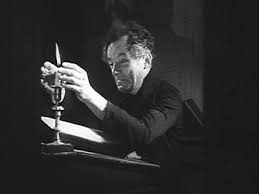
This version opens on Christmas Eve in 1843. Ebenezer Scrooge (Seymour Hicks) is a cold-hearted and greedy elderly money-lender working away in his freezing counting house. In the next room, the long-suffering Bob Cratchit (Donald Calthrop) is working. Under-paid, Bob tries to stay warm by the heat of his candle.

Bob Cratchit (Donald Calthrop) tries to warm himself with the candle he works by.

Two fellow businessmen, Middlemark (Charles Carson) and Worthington (Hubert Harben), come to Scrooge’s counting house to collect a donation for the poor at Christmas. But Scrooge insists he instead supports the prisons and workhouses where the poor are supposed to go. When told that many of them would rather die than go there, he even goes as far to say if the poor would rather die then they “better do it and decrease the surplus population.”

When Scrooge catches Bob trying to take some coal from the bin to stoke the fire that heats the office, he threatens to fire him if he does not get back to work.

Scrooge's (Seymour Hicks) nephew Fred (Robert Cochran) comes
to visit and to invite him to dinner on Christmas Day.

Next, Scrooge is visited by his only relative, the son of his departed sister, Fred (Robert Cochran). Fred invites his uncle to come to his house to celebrate Christmas with him and his wife, to which Scrooge replies that Christmas is 'Humbug!'.

Reluctantly, Scrooge gives Bob the next day off, but he makes him promise to be early the next day.
That night, Bob goes home to celebrate with his family, while Scrooge dines alone in a pub.

Meanwhile, the upper crust of London celebrates Christmas with the Mayor.

The face of Scrooge's dead partner Marley appears on his door knocker.

When he gets home, Scrooge sees the face of his seven-year dead partner, Jacob Marley, in his front door knocker. Later that night, he is confronted by Marley’s ghost (voiced by Claude Rains). In this version, the ghost is invisible, even to Scrooge, though you can hear the chains he forged. Marley informs Scrooge that in order to escape his fate, he will be visited by three spirits.

Scrooge is visited by the Ghost of Christmas Past (Marie Ney). 

Scrooge is first visited by the Ghost of Christmas Past (Marie Ney), who is visible only as a white silhouette with no facial features. He shows Scrooge the moment he lost his fiancĂ©e, Belle (Mary Glynne). A debt-ridden couple (Maurice Evans and Mary Lawson) beg for more time to pay their debt, but greedy Scrooge demands payment. Disappointed by his treatment of them, she leaves, breaking off their engagement. Scrooge then sees what’s happened to Belle. Married, Belle now has several children with her husband (Garry Marsh) and is happy.

Disappointed in how he treats his debtors, Belle (Mary Glynne) breaks off their engagement.

Next up, Scrooge is visited by the Ghost of Christmas Present (Oscar Asche), who unlike his fellow ghosts, takes human form and speaks aloud.

The Spirit of Christmas Present (Oscar Asche) visits Scrooge.

He takes Scrooge to the house of Bob Cratchit and his family. They may have a meager dinner of goose and pudding, but they are happy to be together. Among his family with his wife (Barbara Everest) include Tiny Tim (Philip Frost), an invalid child, forced to walk with a crutch. The ghost warns Scrooge that unless things change, Tim will die. Scrooge is then shown how others celebrate Christmas, including Fred with his wife (Eve Gray) and their friends.

The Cratchit family makes the most of their Christmas, including Tiny Tim (Philip Frost).

Next, Scrooge is visited by the Ghost of Christmas Yet To Come, depicted only as an ominous dark shadow. The Ghost shows Scrooge what lies in the store for the coming year. First, he is shown a tombstone of an unknown man. Scrooge learns that Tiny Tim has died.

He also sees his charwoman (Athene Seyler), his laundress (Margaret Yarde) and an undertaker (D.J. Williams) meeting up at Old Joe’s (Hugh E. Wright), a pawnbroker who gives them pennies on the dollar, so to speak, for the items they admit they took off a dead man.

After that, he sees some businessmen that he knows talking rather reserved about an associate’s death, more concerned about his money than the man. Demanding to see the name on the grave, Scrooge is shown that it is, in fact, his own.

In the morning, Scrooge is a changed man.

In the morning, Scrooge wakes up a changed man and feeling generous. He gives his Charwoman a tip and the day off. He flings open the window and calls out to a boy on the street and have him fetch the Poulterer (Morris Harvey) with the prize turkey in the window. Scrooge has the turkey delivered to Bob Cratchit.

The Poulterer (Morris Harvey) is summoned by the boy to Scrooge's.

Next, he goes to Fred’s and, as a surprise but welcomed guest, joins in on the festivities.

Fred and his wife (Eve Gray) will welcome Scrooge in their home.

The next morning, Bob arrives late and finds Scrooge is already there waiting for him. Expecting to be disciplined or fired, he is surprised to find that instead, Scrooge gives him a raise. He promises to be a stepfather to Tim and even attends church together with him.

Arriving late for work, Bob is surprised to get a raise from Scrooge.

Originally released in the UK by Twickenham Studios on November 26, 1935, with a running time of 78 minutes, it was released soon afterward in the U.S. by Paramount Pictures on November 30th, but in an edited form, running only 63 minutes. The 15 minutes of deleted scenes include: The visit of the two men seeking donations; Much of the dinner at the Cratchit's, including Tiny Tim saying "God bless us, everyone"; Brief scenes on a lighthouse and a sailing ship; The party at Fred's while Scrooge and Christmas Present watch; and the ending where Scrooge meets Bob Cratchit at church.

It should not come as a big surprise that this film is not well-known in the U.S., having been overshadowed by MGM’s own adaptation, A Christmas Carol (1938), which had a largely British cast, was much more popular and had better production values.

This Scrooge is very much a stripped-down version than modern audiences are used to. There are few of the photographic/special effects that you come to expect when watching a film dealing with ghosts. In this film, we don’t see Marley with his chains and Christmas Past and Future are depicted as featureless silhouettes and shadows. This comes close to be a filmed stage play. Our modern expectations are not met, though that was not what the filmmaker was concerned about at the time.

The director, James A. Carter, using an expressionist style, manages to give Scrooge’s world a very claustrophobic feel through the use of shadows. Scrooge lives in a narrow dark place from his cramped office, hunched over his desk, to his lonely booth in the pub to his bed surrounded and cut off from the rest of the world by curtains. It is only after he’s been visited by the three ghosts does his world open up. Christmas morning with its bright lights contrasts with the dark night of Christmas Eve.

Everything in the film takes a backseat to the performance of Seymour Hicks. Pretty much an unknown in the U.S. now, Hicks was a well-respected actor, theater manager, and playwright during what is referred to as England's Golden Age of Theater (1880-1920). Hicks had a very successful career writing, starring in and producing Edwardian musical comedies, often starring opposite his wife, Ellaline Terriss. But, the role he was best known for and which he claimed to have played over 2,000 times was Ebenezer Scrooge.

He first appeared on stage at the age of nine and became a professional actor at the age of sixteen. With his stage success, Hicks also starred in films, beginning with a silent version of Scrooge (1913). While making a film version of one of his plays, Always Tell Your Wife (1923), a remake of an earlier 1914 film, he fired his original director, Hugh Croise, and hired a young man from the production department at the studio who had never directed before to complete the film, Alfred Hitchcock.

Hicks was not new to filmmaking nor to the role and it shows in his performance. The actor embodies the character of Scrooge, the way a man wears a well-fitted shirt. He is the sole reason to watch this version of Dickens’ A Christmas Carol, though the performance alone might not be enough to place this near the top of the adaptations. The first sound adaptation may not be the best, but it is well worth watching.

To read reviews of other Christmas films, please see our Christmas Review Hub.

Saturday, August 19, 2017

Stubs - How To Sleep (1935)


How to Sleep (1935) Starring Robert Benchley. Directed by Nick Grinde. Screenplay by Robert Benchley. Produced by Jack Chertok. Run Time: 11 minutes. USA. Comedy

Robert Benchley came to Hollywood not to be an actor, but as a screenwriter for film producer Jesse L. Lasky. A humorist by trade, beginning with his work at the Harvard Lampoon, Benchley had been writing professionally since selling his first piece to Vanity Fair in 1914 and worked there with Robert Emmet Sherwood and Dorothy Parker. Together, the three of them would form the basis of the Algonquin Round Table.

When his position at Vanity Fair ended, he was fired, Benchley began freelance work. He began writing a book review column for New York World as well as a syndicated column for publisher David Lawrence. In 1920, he would move on to Life magazine writing theater reviews.

He would get into acting, when the Algonquin Round Table accepted a challenge to put together their own theatrical production, No Sirree!, when actor J.M. Kerrigan tired of the groups’ complaints about the on-going Broadway Theater season. Benchley’s contribution to the show, “The Treasurer’s Report,” in which he played a disorganized man explaining a company’s yearly expenses, was so popular he was asked to perform it, leading to a $500 a week gig at Irving Berlin’s Music Box Revue from 1921 until 1922.

After coming to Hollywood, he received credit for the film You'd Be Surprised (1926), before returning to New York to write the book for a Broadway Musical, Smarty, featuring a dancer/singer named Fred Astaire. But Benchley’s contributions were eventually excised from the final production, Funny Face, with music and words by George and Ira Gershwin.

Following that, Benchley became involved with a talkie version of The Treasurer’s Report (1928). While Benchley was convinced he wasn’t any good in the short, it ended up being well-received. This led to other shorts, The Sex Life of the Polyp (1928) and The Spellbinder (1928), for Fox Movietone. Their success led Benchley to resign from Life, which released a statement, "Mr. Benchley has left Dramatic Criticism for the Talking Movies." While filming these shorts, he began to write for the New Yorker magazine. But that took him away from Hollywood for a number of years.

Benchley would return in 1931 to do writing and voice-over work on Sky Devils (1932), a pre-code aviation comedy starring Spencer Tracy and Ann Dvorak. That same year, he would act in his first feature, The Sport Parade, with his future Foreign Correspondent (1940) co-star Joel McCrea. Following the success of the film, Benchley was offered a writing and acting contract by RKO Pictures.

As part of that contract, Benchley would have a prominent role as a salesman in Rafter Romance (1933), which starred Ginger Rogers. His work at RKO garnered the interest of MGM, who offered him a lot of money to produce a series of short films, or Miniatures as they were called, the first of which was How to Sleep (1935).

Inspired by a Mellon Institute of Industrial Research (now part of Carnegie Mellon University) study on sleep commissioned by the Simmons Mattress Company, production lasted all of two days. In the film, Benchley, who wrote the script, serves as both narrator and subject of the mockumentary or parody of instructional films.

Robert Benchley narrates How To Sleep, pretending to be an expert on the subject.

The film is presented by Benchley the narrator as a sort of Part 2 to a recent and fictional film about staying awake. He tells the audience that this film will cover the four aspects of sleep: causes of sleep, methods of sleep, avoiding sleep, and waking up.

Animated sequence demonstrating the brain leaving the blood in the head of an alcoholic.

According to the film, the main cause of sleep is blood leaving the brain. The next joke, “Or, as in the case of alcoholics, the brain leaving the blood,” is one of the several references made about heavy drinking and sleep. It is somewhat interesting to note, that while Benchley had been a teetotaler in his youth, he had become a heavy-drinker by then and would ultimately die from cirrhosis of the liver on November 21, 1945, at the age of 56. So, the jokes about alcohol no doubt came from experience.
When instructing on methods to get to sleep, Benchley starts with taking a pine seed bath, but the water is too hot, so he walks away.

Robert Benchley prepares warm milk to help himself sleep.

Next, he suggests drinking warm milk, but when he goes to put the milk back in the ice-box, he finds cold lobster, coleslaw, and then cold chicken. He picks at everything before deciding to get comfortable and takes all the leftovers to the kitchen table and has a mini-feast, leaving the milk unattended on the burner, with the suggestion that it's best to have someone bring you the warm milk in bed.

Benchley distracts himself with leftovers in his ice box.

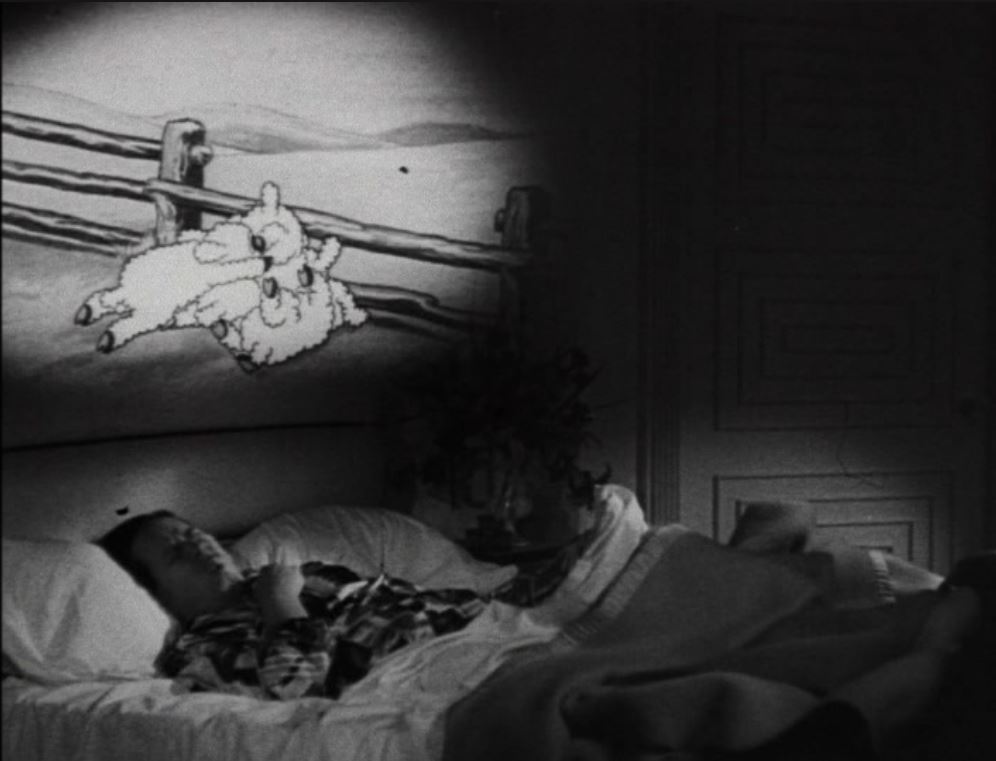
After that, he discusses the practice of counting sheep, but warns that the sleeper may start to worry about the sheep themselves being able to clear the fence, to the point of distraction. Sure enough, one of the sheep in his dream crashes into the fence.

When Benchley counts sheep, they crash into each other.

As far as distractions that prevent sleep, he points out the flapping of a mini blind, but once that’s cured with a chair, there is the dripping faucet in the bathroom. And of course, there is the problem with a mosquito that he can’t seem to kill, instead retreating under his sheet and blanket for protection.

Dripping water from his cold water faucet keeps Benchley from getting to sleep.

Then there is the issue of the effects of alcoholism on sleeping, a problem Benchley may have been all too aware of from personal experiences. He shows himself suddenly bolting out of bed, or what he calls the leaping jitters. As narrator, Benchley talks about himself in the third person until Benchley tells himself to mind his own business.

Benchley demonstrates the "leaping jitters" that alcoholics suffer with.

Finally, there is the issue of faulty bed-making, leaving the bedclothes askew, causing sleeplessness due to discomfort.

A supposed study into sleeping positions that the film delves into.

Next, the film reviews various sleeping positions, at least making reference to a sleep study, which timed how long a sleeper was in certain positions. Going so far as giving them sports/scientific sounding names like Sleeping/sitting/standing/crouch. Then in what is supposed to be sped up photography, is really just a “sleeper” flopping on a bed with a sped-up clock next to them.

Demonstrating the sleeping/sitting/standing/crouch position.

Getting back to distractions, there is the sudden realization of thirst. While there are options to ignore the desire and perhaps die of thirst, Benchley opts for trying to get out of bed and get the water without becoming too awake. Not only does he get water everywhere, even on himself, but when he tries to get back in bed, he slips and falls on his own shoes on the floor.

Benchley tries to get water without completely waking himself up. It doesn't work.

With all the problems and distractions, Benchley finally gets to sleep, but only minutes before the alarm is set to go off. The yawning Benchley in bed becomes our yawning narrator, who apparently needs to learn for himself How to Sleep.

In the end, Benchley, the narrator, demonstrates that he doesn't know how to sleep.

The film was released on September 14, 1935, to great praise, in fact receiving the best reception of all of Benchley’s Miniatures. It would go on to win the Academy Award for Best Short at the 8th annual awards show. Only one other of the Miniatures would even be nominated, A Night at the Movies (1937), which Benchley would also write, something he didn’t always do with this shorts program. Regardless, he would end up making 25 Miniatures at MGM through 1939.

Benchley would also continue to act in feature films, including such films as Foreign Correspondent and The Major and the Minor (1942). He is usually a featured player and used for comedic relief.

How To Sleep deals with an eternal issue, as old as mankind. There are all sort of aids and mattresses being advertised that are supposed to provide safe, restful sleep. Still, insomnia and sleep disorders are still national issues, as many Americans, yours truly included, never get enough sleep at night. In fact, the same night I watched this short for the second time I found out I had to serve Jury Duty the next morning. With that hanging over my head, I couldn’t get to sleep. As Benchley states so succinctly, “No matter what it is, you’ll find it easy enough to worry about in the middle of the night.” Rooted somewhat in facts and old wives’ tales, How To Sleep does touch on several methods, short of sleeping pills, that can affect getting a good night’s sleep.

And as eternal as the issue is, the film itself is a snapshot of the time it was made. The ice-box and separate hot and cold-water faucets seem so out of date. At the same time, though you have to wonder how Benchley’s lifestyle represents America during the Depression. How many Americans had cold lobster in their ice boxes, or got up as late as 7:30 in the morning before going to work, if they even had a job at all.

The film was directed by Nick Grinde, a director considered one of American cinema’s early B film specialists. He is perhaps best known for The Man They Could Not Hang (1939), starring Boris Karloff, and for Ronald Reagan’s first film, Love is on the Air (1937). While those may not sound like comedic-chops, he did co-write the Laurel and Hardy classic Babes In Toyland (1934) that was released the year before How To Sleep. However, it is hard to say how much of the film's humor is really due to Grinde’s direction and how much is due to Benchley, though the latter’s presence is what makes the film worth watching.

Easily the wittiest guy in any room, Benchley has a way of seeming authoritative while cutting himself down in the process. Narrator Benchley talks about himself in the third person and that third person Benchley isn’t above giving the narrator Benchley a piece of his mind. A man of words, Benchley also had a physical comedy gift as well that is on display throughout most of the film. While How To Sleep may not be laugh out loud funny today, it is still an example of parody that we don’t see very much anymore; the button-down collar variety.

Saturday, October 17, 2015

Stubs - Mad Love


Mad Love (1935) Starring: Peter Lorre, Frances Drake, Colin Clive, Ted Healy. Directed by Karl Freund. Screenplay by P. J. Wolfson, John L. Balderston. Based on the novel Les Mains d'Orlac by Maurice Renard (Paris, 1920). Produced by John W. Considine Jr. Run time: 68 minutes. US. Black and White. Horror

You hear about films from all different sources. In the case of Mad Love, we were trying to find a film that we heard about at Comic Con of all places at a panel hosted by the Warner Archives, a division of Warner Bros. dedicated to showcasing older and usually obscure films and television shows. What we remembered was the film starred Peter Lorre and had something to do with the hand of a pianist being cut off. (I've later found out they were talking about The Beast With Five Fingers (1946)). When we came across this film (with the elements of Peter Lorre, severed hands and pianist), we thought we had found the one they were hyping. 

Mad Love marked Peter Lorre’s American film debut and Karl Freund’s last directorial effort. Lorre had come to the U.S. after leaving Germany when the Nazis came to power. He had made an international sensation starring in Fritz Lang’s M (1931). The film would typecast Lorre as a villain. After moving to Paris and London, where he appeared in Alfred Hitchcock’s The Man Who Knew Too Much (1934), Lorre would come to Hollywood under contract to Columbia Pictures. But that studio would have trouble finding the right film for him and lent him out to MGM in an effort to recoup some of their investment.

Freund, who had also come from Germany, had been a sought after cinematographer in Hollywood. He was given an opportunity to direct The Mummy (1931) and directed six more films at Universal, before moving to MGM. There he was teamed with Lorre on what would turn out to be his last directing assignment.

Writer Guy Endore worked with Freund on early drafts of a script based on a recent translation of Maurice Renard’s novel Les Mains d'Orlac (The Hands of Orlac). The book had already been made into a movie about a decade before: Orlac Hnde (1924), an Austrian film directed by Robert Weine and starring Conrad Veidt and Alexandra Sorina.

Producer John W. Considine Jr. assigned P.J. Wolfson and John L. Balderston to do rewrites on Endore’s script. Balderston seems to be a good choice for horror, having worked on the scripts for Dracula (1931), Frankenstein (1931), The Mummy (1932) and The Bride of Frankenstein (1935). Balderston’s rewrites began on April 24, 1935 and were still in progress when the film went into production on May 6th. Filming would be completed on June 8th and the film would be released in the U.S. on July 12th.

In the film, Doctor Gogol (Peter Lorre) is obsessed with Yvonne Orlac (Francis Drake) the actress starring in at the 'Théâtre des Horreurs' in Paris, France. Gogol goes every night, sitting in the same booth. After the 47th and final show, Gogol goes back stage to meet his object of fascination.


Dr. Gogol (Peter Lorre) goes backstage to meet Yvonne Orlac (Francis Drake), but finds out she's already married.

He is very disappointed that the show is closing, but even more so when he finds out that Orlac is married to Stephen Orlac (Colin Clive), a rising pianist and composer.


Dr. Gogol (Peter Lorre) admires the wax figure of Yvonnw Orlac in the lobby of the theater.

With the show closing down, a wax figure of Yvonne is about to be sent to be melted down, when Gogol intercepts it and pays three times what it’s worth to have it delivered to his house the next day. Gogol goes home to his clinic where he regularly performs surgeries, with the assistance of Dr. Wong (Keye Luke), that save children’s lives.

Dr. Wong (Keye Luke) prepares for surgery with Dr. Gogol.

Meanwhile, Stephen is on a train heading back to Paris. En route, the train stops to pick up a new passenger, Rollo (Edward Brophy), an American circus knife thrower and convicted murderer. Rollo has an appointment the next day with the guillotine.

Enter American reporter Reagan (Ted Healy), who has been sent to cover the execution of Rollo for his paper. Prefect Rosset (Henry Kolker) is in charge of the execution and cooperates with Reagan. Rosset makes a point of calling Gogol letting him know about the execution, since Gogol never misses one.

Rosset and Reagan go down to the train station to wait and there they run into Yvonne. News comes that there has been a wreck and Reagan and Yvonne take a cab to the site. It is Yvonne going through the wreckage who finds Stephen’s body. Dr. Marbeau (Charles Trowbridge), the first doctor who examines Stephen, tells Yvonne that her husband will live, but that his hands will have to be amputated. Yvonne pleads with the doctor to let her take her husband to Gogol. The doctor is too busy to argue and lets her take her husband to Paris.

Back in Paris, Gogol is there with Reagan to watch Rollo get executed. When Gogol returns to his home, he sees the ambulance leaving and is told that Yvonne came looking for a favor. Gogol immediately agrees to help, but upon examination also determines that Stephen’s hands will have to be amputated. Yvonne is distraught at the news, telling Gogol that she had hoped Gogol could help her.


Rollo (Edward Brophy) is being led to the guillotine.

While preparing for surgery, Gogol gets the idea to use Rollo’s hands and calls Rosset who is already willing to cooperate with Gogol’s experiments.

Unaware of the experiment performed on him, Stephen is told that he will eventually get the feeling back in his hands, but it will take long and expensive treatments for him to be able to use them like he had. The expense practically bankrupts the young couple and try as he might, Stephen can’t seem to recover his old form. He is about to give up, but Yvonne encourages him to keep practicing. When a bill collector comes to get payment for Stephen’s piano, Stephen becomes enraged and hurls his penknife at the man.


Stephen Orlac (Colin Clive) realizes that something is wrong with his hands.

Needing money, Yvonne suggests that Stephen go see his step-father Henry Orlac (Ian Wolfe), a jeweler, but his father refuses to give Stephen money and suggests that Yvonne should go back to acting and do other things to make ends meet. Upset by his father’s insinuation, Stephen, with an employee of his father as a witness, throws a knife at his father, barely missing him.

Gogol, who has set up the wax figure of Yvonne in his front parlor, goes to Yvonne and asks for her love, but she refuses. Stephen goes to Gogol's home and tries to find out about his hands, and why they throw knives. Gogol suggests that Stephen's problem originates from a childhood trauma.


Stephen tries to get answers from Dr. Gogol, but nothing is satisfactory.

Not satisfied with that answer and concerned that his hands seem to act on their own, Stephen goes to see Dr. Marbeau. Marbeau concludes that the hands are not Stephens, since they had been crushed beyond repair.

Soon after his visit, newspapers report that Stephen’s stepfather has been found murdered. Stephen is called to a meeting with a mysterious figure, who reveals himself to be Rollo, claiming Gogol had reattached his head, but had taken his hands and given them to Stephen. Rollo, who is really Gogol in disguise, convinces Stephen that he had murdered his father.


Gogol, disguised as Rollo, convinces Stephen that he's murdered his own father. 

Stephen is arrested and the police are baffled that his fingerprints match those of Rollo’s.

Meanwhile, panic stricken, Yvonne decides to investigate Gogol for herself. Françoise (May Beatty), Gogol's drunken housekeeper, thinks the wax statue has come to life and runs from the house into the arms of two policeman who, thinking she’s crazy, take her away. In Gogol’s parlor, Yvonne sees her statue and takes it place when Gogol returns home in his Rollo disguise.


Gogol removes his Rollo disguise.

He’s so pleased with himself that he pleads his love to Yvonne and sits down to play the organ for her, like he does every night. With his back turned, Yvonne is attacked by Gogol’s pet bird. Seeing her bleed, Gogol thinks his love has brought the wax figure to life. But she refuses him again. Voices in his head convince him to kill her by strangling her with her own hair.

Gogol plays the organ for Yvonne, but thinks she's the wax figure replica.

Yvonne is saved when Reagan, Stephen and the police arrive at Gogol’s house. The door to his parlor is locked and they are only able to open the observation window. But that’s enough for Stephen, who throws a letter opener he swiped from the prefect’s desk at Gogol, hitting him in the back and killing him.

No film made in Hollywood at this time could escape the Hays Office. MGM was warned during pre-production from making a film that was "too brutal or too shocking." They were discouraged from showing the train wreck or the aftermath with dead and dying bodies.

They also wanted them to tone down the creep factor with Gogol’s infatuation with the wax Yvonne by not showing him fondling it or spraying it with perfume. Nevertheless, Mad Love had trouble in other countries. Either banned outright or only allowed to show in a censored form, eliminating one or more scenes of torture, guillotining or strangulation.

Mad Love wouldn’t be the last film to be made, based on Renard’s novel. Filmmakers would return to the book for The Hands of Orlac (1964) a French-British film starring Mel Ferrer and directed by Edmond T. Greville. Before that, Hands of a Strangler (1962), was made, loosely based on the novel. Written and directed by Newt Arnold, the film starred Paul Luthaker and Joan Harvey.

Peter Lorre makes a strong impression in his American film debut. He would go on to appear in a variety of films, including supporting roles in two of my favorite films, The Maltese Falcon (1941) and Casablanca (1942). While he is associated with Humphrey Bogart, Lorre made nine films with Sydney Greenstreet. A versatile actor, Lorre would appear in comedies: Arsenic and Old Lace (1944), war films: Passage to Marseille (1944) and horror: the above mentioned The Beast with Five Fingers.


Peter Lorre getting his head shaved for his role as Dr. Gogol.

After his Warner Bros. contract expired, Lorre’s career in Hollywood took a downturn. In 1950, he returned to Germany, where he co-wrote, directed and starred in Der Verlorene (The Lost One, 1951), a film noir.

He would return to the U.S. in 1952 and played Le Chiffre in the television adaptation of Casino Royale (1954) opposite Barry Nelson as Jimmy Bond. He also would star with Kirk Douglas and Jams Mason in 20,000 Leagues under the Sea (1954). In his later years Lorre would work on television in guest roles and make low budget films with Roger Corman. He would die of a stroke in 1964.

Frances Drake, the actress who played Gogol’s object of fascination, had a short Hollywood career. An American, she lived in Canada and got her start in the U.K. as a nightclub dancer. She appeared in a few films there under her birth name Frances Dean, including Meet My Sister (1933) and The Jewel (1933) before coming to the U.S. under contract to Paramount.

She appeared opposite George Raft in a couple of films, Bolero (1934) and The Trumpet Blows (1934), and followed that with Ladies Should Listen (1934) opposite Cary Grant. During her career she would never be a top-billed actress, but would act in a variety of genres, including more horror: The Invisible Ray (1936); comedy/mystery: The Preview Murder Mystery (1936) and There’s Always a Woman (1938); and romantic comedy: It’s a Wonderful World (1939).

Drake married the Hon. Cecil Howard, second son of Henry Howard, 19th Earl of Suffolk in 1939 and shortly thereafter retired from films.

While Peter Lorre received a lot of critical attention for his performance, the film was not well received. Made on a budget of $408,000, the film only made $364,000 at the box office worldwide. Financially not an auspicious start for Lorre's Hollywood career.

The premise of Mad Love must have seemed like science fiction and probably was back in 1935; hand transplantation is now a real thing. The first transplant, which was rejected, occurred in Ecuador in 1964, but more recent surgeries have been finding long term success. I haven’t read anything about the hands retaining the muscle memory of their previous owner.

I find the story to have a very interesting twist. Rather than letting the killer’s hands continue to kill indiscriminately, as one might expect, the story has Stephen use his new found talent to save his Yvonne, when Gogol tries to strangle her.

While not a great film, Mad Love is nevertheless interesting and entertaining. It is definitely worth watching especially if you’re in the mood for offbeat horror.

Be sure to check out our other Horror film reviews here.

Saturday, August 29, 2015

Stubs - The Whole Town's Talking (1935)


The Whole Town’s Talking (1935) Starring: Edward G. Robinson, Jean Arthur, Arthur Hohl, James Donlan Directed by John Ford. Produced by Lester Cowan. Screenplay by Jo Swerling and Robert Riskin. Based on the story "Jail Breaker" by W. R. Burnett in Collier's (Jul--Aug 1932). Run Time: 93 minutes. U.S.  Black and White. Comedy, Gangster

Two people that you don’t really think would have worked together in Hollywood are John Ford and Edward G. Robinson. Ford is forever connected to the Western genre of films and Robinson is typecast as a gangster and a contract player at Warner Bros. So when I learned the two worked together on a comedy and at Columbia Pictures, a certain amount of interest was raised.

Ford may be best known for his many Westerns, including such classics as Stagecoach (1939), The Searchers (1956) and The Man Who Shot Liberty Valance (1962), but he also directed The Grapes of Wrath (1940) and How Green Was My Valley (1941).

Robinson would make more comedies, most notably A Slight Case of Murder (1938), which is one of the reasons this film caught my attention in the first place. Robinson, despite being type-cast as a gangster, was a very versatile actor.

Arthur Ferguson Jones (Edward G. Robinson) is late for work for the first time in eight years. He’d bought a new alarm clock, but when it says its 7:30, it’s really past 9. While Jones is late for work we learn that he has ambitions to be a writer and has a bird and a cat for pets. Jones’ day job is working as a clerk (I’ve read several synopsis that say he works at as an advertising clerk, but what he actually does isn’t made very clear.) The owner of the company, J.G. Carpenter (Paul Harvey), wants floor manager Seaver (Etienne Girardot) to make an example of the first person who is late for work, not imagining it would be Jones, whom he also instructed Seaver to give a raise.

Seaver is put in an odd situation, but is rescued when someone comes in even later. Wilhemina "Bill" Clark (Jean Arthur) doesn’t get to work until 9:30. Clark is the object of Jones's unspoken love; he has a photograph of hers, which we learn he stole, up in his apartment as inspiration for his writings. Clark puts her feet up and reads the paper and recognizes the resemblance between a picture of escaped convict "Killer" Manion and Jones, which she points out to a co-worker and soon it is all over the floor.

Wilhemina "Bill" Clark (Jean Arthur) is the object of  Arthur
Ferguson Jones' (Edward G. Robinson) affections.

While Jones lunches at a restaurant, the obsequious Hoyt (Donald Meeks) also notices the similarity and calls the police, hoping to collect the $25,000 reward for his capture. Jones and Clark are taken into custody. Everyone at the police headquarters is convinced they’ve captured Manion. Even Carpenter, who is called down to identify Jones, is convinced he’s Manion. It takes Seaver, who works directly with Jones to establish his identity. Forensics also discovers that his fingerprints are not the same as Manion's. To protect him from another mistaken arrest, District Attorney Spencer (Arthur Byron) gives Jones a special passport to show wary policemen he is not who they think he looks like.

Hoyt (Donald Meeks) thinks he recognizes Manion and calls the police.

Back at the office, "J.G." encourages Jones, an aspiring writer, to sign a deal with newspaperman Healy (Wallace Ford) to author a special serial on his own appraisal of Manion, based on him looking like the gangster. The three men get drunk together, and when Jones returns to the office he kisses the thrilled Clark and tells Seaver Carpenter has authorized putting her back on the payroll.

Jones gets drunk with his boss, J.G. Carpenter (Paul Harvey), and a newspaperman named Healy (Wallace Ford).

But Jones’ buzz gets killed when he gets back to his apartment and finds Manion waiting for him. Manion demands the use of the passport at night to protect him during his criminal activities. Although for the first time in Jones' life everyone is deferential toward him, and Clark affectionately asserts control over his career, Jones lives in perpetual fear of Manion, who has moved in with him.

When Jones finds Manion (Edward G. Robinson) waiting for him in his apartment.

The publicity-seeking criminal demands that Jones's newspaper series be turned into his reminiscences, which raises the suspicion of authorities when Jones writes details about Manion’s escape that were not public knowledge.

When Healy brings Jones’ first paycheck to the office, Jones is not there, but Clark offers to take it to him. But she doesn’t recognize Manion and kisses him. When she sees his gun in its holster she beats a hasty retreat, but Manion has a couple of his boys follow her. When she hurries to the nearest pay phone to call the authorities, they intercept her and take her hostage.

Trying to protect Jones, the district attorney orders him placed under protective custody in prison. Accompanied by a couple of hapless police officers, Detective Sergeant Boyle (Arthur Hohl) and Detective Sergeant Howe (James Donlan), Jones goes back to his apartment, but Manion is still there and takes Jones's place and the two police don’t realize it. Manion goes to the prison to kill fellow gangster, "Slugs" Martin (Ed Brophy), who had turned stool pigeon on him to authorities.

Jones is recalled to the city, but not before Manion has a chance to kill Martin. Seaver, who had come to visit who he thought was Jones and bring him work to complete, catches a ride with Manion back to the train station, but Manion takes control of the car and kidnaps Seaver. The disappearances of Seaver and Clark tip off authorities to the true state of affairs.

Manion decides to take advantage of his mild-mannered doppelgänger and, ultimately, leave Jones "holding the bag" for Manion's crimes. He kidnaps Wilhelmina, Jones' visiting aunt, and a few others, and takes them back to his hideout. He instructs Jones to make a large deposit for Manion's mother's benefit at the First National Bank and then tips the police that Manion will attempt to rob the bank, so police are waiting for him. Jones forgets to bring the check and unwittingly leads the police back to Manion's hideout.

Upon his arrival, Jones is mistaken for Manion by the waiting henchmen and quickly figures out he’s meant to be the fall guy. Manion returns unexpectedly and Jones orders the men to shoot him. The police arrive in time to capture the rest of the gang when they try to make a run for it. Even though Hoyt arrives on scene to inquire about the reward, Jones is given the credit and the money. With his pets and, more importantly, with Wilhelmina, Jones takes off for his long-desired cruise to Shanghai.

At the end, Jones and Wilhelmina take off for this long-desired cruise to Shanghai.

While the film has a happy ending, I’m not really sure I would consider it a comedy. There are too many murders and not enough laughs to qualify for me. Much of the humor is supposed to come from the mistaken identity of mild-mannered Jones for cutthroat criminal Manion. Robinson is more than capable of playing both, but the humor wears thin. Jokes get set up, like Jones leaving his bathtub overflowing when he rushes off to work on his only day late, but there are no consequences. When he returns home, there are no ill effects.

The film, however, was apparently so popular at the time of its release that it made Jean Arthur a star at the age of 35. Her Clark is a fast-talking street-wise girl with a heart of gold, a character type she would be called upon to play for the rest of her career.

The Whole Town's Talking made Jean Arthur a star in Hollywood.

The film brought Arthur to the attention of Frank Capra, one of Columbia’s better directors. He would work with Arthur in such films as Mr. Deeds Goes to Town (1936); You Can’t Take It With You (1938); and Mr. Smith Goes to Washington (1939). In these films, she played roles very similar in type to Clark.

The spirit of Capra is all around The Whole Town’s Talking, in addition to Arthur, the script was co-written by Robert Riskin, who penned American Madness (1932); It Happened One Night (1934); Mr. Deeds Goes to Town (1936); Lost Horizon (1937); You Can’t Take It With You; Meet John Doe (1941); and Pocketful of Miracles (1961) all films directed by Capra. The Whole Town’s Talking, though, lacks Capra’s humorous and poignant touches.

I’m not sure what exactly went wrong, but The Whole Town’s Talking didn’t click with me. I’m pretty much a fan of everyone involved in the production from director, John Ford, to the stars Robinson and Arthur, to the screenwriter, Riskin, to even the supporting cast members like Donald Meeks. But somehow the parts don’t add up to a greater whole.